Measure Your Organization’s People-First AI Readiness
Artificial intelligence is moving into the workplace quickly, but access to AI tools does not automatically mean an organization is ready to use them well.
Many companies are experimenting with AI, launching new platforms, training employees, and encouraging adoption. But real AI readiness depends on more than tool access. It depends on whether employees understand where AI fits, trust the tools they are expected to use, know how to review AI-assisted work, and have a clear way to provide feedback when the process does not work.
The PFAIF™ Readiness Assessment was created to help organizations evaluate those conditions.
PFAIF stands for the People-First AI Implementation Framework. It is a practical framework for assessing whether an organization has the workflow, communication, training, quality, trust, and reinforcement systems needed to implement AI in a sustainable way.
This assessment is designed for business leaders, AI implementation teams, consultants, HR leaders, operations teams, and change management professionals who want to understand whether their organization is prepared for people-first AI adoption.
What the PFAIF Readiness Assessment Measures
The PFAIF Readiness Assessment evaluates AI readiness across eight people-first implementation areas:
- Workflow Assessment
Whether the organization understands the workflows AI is expected to support before introducing or expanding AI tools. - Use Case Definition
Whether AI use cases are clearly connected to specific problems, intended outcomes, responsible teams, and success criteria. - Change Communication
Whether leaders clearly explain why AI is being introduced, how it will affect work, and how employee concerns will be addressed. - Role-Specific Training
Whether employees receive AI training that connects directly to their actual roles, tasks, judgment calls, and quality expectations. - Quality Standards
Whether the organization has clear expectations for reviewing, validating, and approving AI-assisted work. - Pilot Testing
Whether AI use cases are tested with real users and real workflows before they are scaled more broadly. - Adoption and Trust Measurement
Whether the organization measures not only AI usage, but also employee trust, usefulness, rework, confidence, and workflow value. - Reinforcement and Feedback Loops
Whether AI adoption is supported after launch through feedback, coaching, documentation, workflow updates, and continuous improvement.
Together, these areas help identify whether AI adoption is being treated as a people-first implementation process or simply as a tool rollout.
Who Should Take the Assessment?
The PFAIF Readiness Assessment is useful for anyone involved in planning, managing, supporting, or evaluating AI adoption at work.
You may benefit from the assessment if you are:
- A business owner deciding how to introduce AI into daily operations
- An executive or department leader responsible for AI adoption
- An HR or learning leader developing AI training programs
- A consultant advising clients on AI implementation
- A change management professional supporting employee adoption
- An operations leader trying to improve workflows with AI
- A manager trying to understand why employees are not using AI consistently
- A researcher or practitioner studying workplace AI readiness
The assessment can be used before an AI rollout, during a pilot, after early adoption, or as part of a broader AI readiness review.
Why AI Readiness Matters
AI implementation can fail even when the technology works.
A tool may be powerful, but employees may avoid it if they do not trust it. A platform may be available, but teams may not know when to use it. AI may save time in one part of a workflow while creating extra review, correction, or confusion somewhere else.
That is why people-first AI readiness matters. Organizations should not only ask: “Do we have AI tools?”
They should also ask: “Do employees understand how AI fits their work? Have we defined clear use cases? Have we trained people by role? Do we have quality standards for AI-assisted work? Are we measuring whether employees trust the tools? Do we know whether AI is reducing work or creating rework? Are we using employee feedback to improve the process?”
The PFAIF Readiness Assessment helps make those questions visible.
How to Interpret Your Results
Your assessment results are intended to help you identify strengths and gaps in your organization’s people-first AI readiness.
A higher score suggests that your organization may have stronger systems in place to support AI adoption. A lower score suggests that important implementation conditions may need more attention before AI is scaled more broadly.
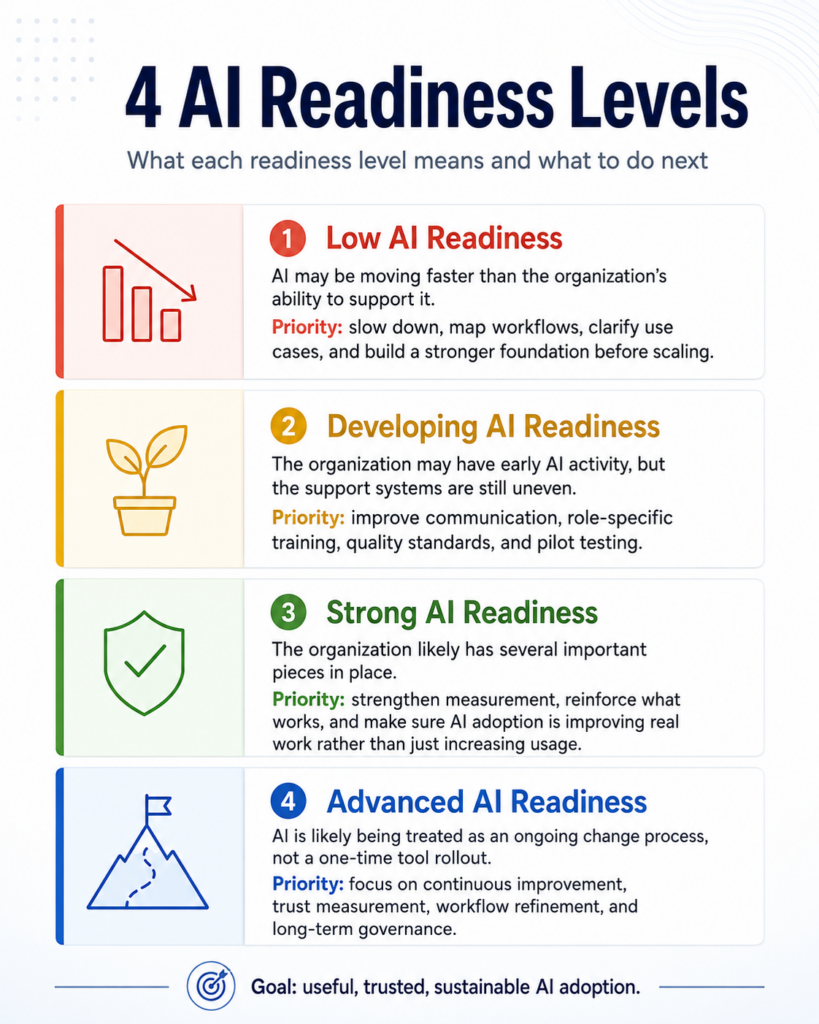
The most useful way to interpret your result is not only to look at the overall readiness level, but also to look at which areas are weakest.
For example:
- A low Workflow Assessment score may suggest that AI is being introduced before the organization fully understands the work it is meant to improve.
- A low Use Case Definition score may suggest that employees are being asked to use AI without clear problems, outcomes, or success criteria.
- A low Change Communication score may suggest that employees do not understand why AI is being introduced or how it will affect their work.
- A low Role-Specific Training score may suggest that employees need more practical, job-specific guidance.
- A low Quality Standards score may suggest that the organization has not clearly defined how AI-assisted work should be reviewed.
- A low Pilot Testing score may suggest that AI use cases are being scaled before they have been tested in real workflows.
- A low Adoption and Trust Measurement score may suggest that the organization is measuring access or usage, but not whether employees trust AI or find it useful.
- A low Reinforcement and Feedback Loops score may suggest that AI adoption is being treated as a one-time launch instead of an ongoing change process.
The goal of the assessment is not to label an organization as good or bad at AI. The goal is to identify where stronger implementation support may be needed.
What to Do After Taking the Assessment
After completing the PFAIF Readiness Assessment, review your results and identify your lowest-scoring areas.
Then use those areas to guide your next steps.
- If your lowest area is workflow assessment, start by mapping the work before choosing more tools.
- If your lowest area is use case definition, clarify the specific AI use cases, expected outcomes, and success criteria.
- If your lowest area is communication, improve the way leaders explain the purpose, impact, and limits of AI adoption.
- If your lowest area is training, build role-specific examples, guided practice, and review standards.
- If your lowest area is quality standards, define what must be checked, who owns final approval, and when AI should not be used.
- If your lowest area is pilot testing, slow down broad rollout and test AI with a smaller group first.
- If your lowest area is adoption and trust measurement, start asking employees whether AI is useful, trusted, and improving the work.
- If your lowest area is reinforcement and feedback loops, create a process for collecting feedback, improving workflows, and updating training over time.
The best AI implementation plans are not built around maximum usage. They are built around practical value, employee trust, quality, and sustainable workflow improvement.
About the PFAIF Research Program
The PFAIF Readiness Assessment is part of a broader research and practice program focused on people-first AI adoption, employee trust, resistance, workflow integration, and organizational readiness.
The assessment is based on the People-First AI Implementation Framework, which organizes AI readiness into eight implementation areas: workflow assessment, use case definition, change communication, role-specific training, quality standards, pilot testing, adoption and trust measurement, and reinforcement and feedback loops.
A formal academic manuscript reporting the assessment’s research design, statistical analyses, limitations, and validation evidence has been submitted for peer review. Until that publication process is complete, this page focuses on practical assessment use and high-level interpretation rather than full statistical reporting.
The current goal of PFAIF is to help organizations move beyond surface-level AI adoption and better understand whether they are prepared to implement AI in ways employees can use, trust, and sustain over time.
Important Note
The PFAIF Readiness Assessment is intended as a practical readiness and reflection tool. It is not a legal, technical, HR, security, or compliance audit. Results should be interpreted as guidance for improving AI implementation planning, not as a guarantee of AI adoption success.
For a more complete review, organizations should combine assessment results with employee feedback, workflow analysis, AI governance review, security and privacy review, and business performance data.
Suggested Citation for the PFAIF Readiness Assessment
APA Style
Karaman, J. (2026). PFAIF Readiness Assessment. JasonKaraman.com. [https://jasonkaraman.com/people-first-ai-readiness-assessment/]
MLA Style
Karaman, Jason. “PFAIF Readiness Assessment.” JasonKaraman.com, 2026, [https://jasonkaraman.com/people-first-ai-readiness-assessment/].
Chicago Style
Karaman, Jason. “PFAIF Readiness Assessment.” JasonKaraman.com. 2026. [https://jasonkaraman.com/people-first-ai-readiness-assessment/].
FAQ
What is the PFAIF Readiness Assessment?
The PFAIF Readiness Assessment is a people-first AI readiness tool designed to help organizations evaluate whether they are prepared to implement AI in ways employees understand, trust, and can use effectively.
What does PFAIF stand for?
PFAIF stands for the People-First AI Implementation Framework. It is a practical framework for implementing AI in the workplace through workflow assessment, use case definition, communication, training, quality standards, pilot testing, adoption measurement, and reinforcement.
How long does the assessment take?
The assessment is designed to be completed quickly. Most people can complete it in a few minutes, depending on how familiar they are with their organization’s AI adoption efforts.
Who should complete the assessment?
The assessment can be completed by business leaders, managers, consultants, HR professionals, operations leaders, AI implementation teams, or employees with visibility into how AI is being introduced at work.
What does the assessment measure?
The assessment measures readiness across eight areas: workflow assessment, use case definition, change communication, role-specific training, quality standards, pilot testing, adoption and trust measurement, and reinforcement and feedback loops.
Is this an AI tool selection quiz?
No. The PFAIF Readiness Assessment is not designed to recommend a specific AI platform or software tool. It is designed to evaluate whether the organization has the people-first implementation systems needed to support AI adoption.
Can this assessment help before an AI rollout?
Yes. The assessment can be especially useful before an AI rollout because it helps identify gaps in workflow planning, communication, training, quality control, trust measurement, and feedback systems before implementation is scaled.
Can this assessment be used after AI has already been introduced?
Yes. Organizations can use the assessment after AI adoption has started to identify where implementation may be weak, where employees may need more support, and where AI workflows may need to be improved.
PFAIF™ and the People-First AI Implementation Framework™ are trademarks of Jason Karaman.