People-First AI Implementation Framework: The PFAIF Model for Successful AI Adoption
Artificial intelligence is moving into the workplace quickly, but access to AI does not automatically create adoption. Many companies are giving employees AI tools, launching new platforms, and encouraging experimentation, only to find that employees are not using the tools consistently or confidently.
That gap is the problem the People-First AI Implementation Framework, or PFAIF™, is designed to solve.
PFAIF is an 8-step framework for implementing AI in the workplace without creating unnecessary employee resistance. It helps leaders move beyond tool selection and focus on the things that actually determine whether AI adoption works: workflow fit, employee trust, role-based training, clear use cases, quality standards, pilot testing, adoption measurement, and long-term reinforcement.
AI implementation is not just a software project. It is a workplace change management initiative. When leaders treat AI like a basic tool rollout, they often miss the deeper issue. AI changes how employees think about their work, their value, their judgment, their job security, and their role inside the organization.
That is why successful AI adoption has to start with people.
Why AI Adoption Fails When Companies Start With Tools
Many organizations make the same mistake with AI. They start by asking which platform to buy, which model to use, or which automation tool is the most impressive. Those questions matter, but they are not the best starting point.
The better starting point is the work itself.
Before introducing AI, leaders need to understand where work is slow, repetitive, unclear, risky, or overly manual. They need to identify where employees lose time, where quality breaks down, where handoffs fail, and where information is hard to access. Only then should they decide whether AI is the right solution.
The reason is simple: AI cannot fix a workflow the organization does not understand. In some cases, AI may help. In other cases, the real solution may be better documentation, better process design, better data structure, or clearer ownership.
The adoption problem is not theoretical. Workplace AI research cited in the whitepaper shows a sharp divide between executive optimism and employee reality. According to WalkMe’s State of Digital Adoption 2026 report, as reported by Futurism, 54 percent of workers said they avoided their company’s internal AI tools and completed tasks themselves, while one-third said they never used AI at all. The same reporting found that 61 percent of executives trusted AI for complex business-critical decisions, compared with only 9 percent of workers. It also found that 88 percent of executives believed their AI tools were adequate, while only 21 percent of workers agreed.
Those numbers show that the AI adoption gap is not only about training. It is about trust, usefulness, workflow fit, and leadership communication.
Employees do not adopt AI because leadership announces it. They adopt AI when they understand where it fits, trust it enough to use it, know how to review the output, and can clearly see how it helps them do better work.
What Is the People-First AI Implementation Framework?
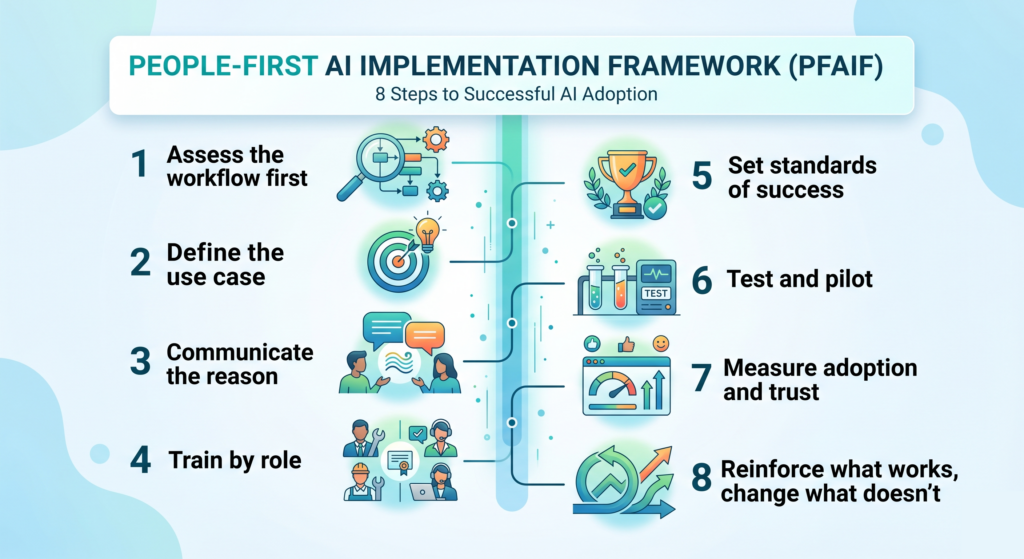
The People-First AI Implementation Framework, or PFAIF, is a practical model for implementing AI in a way that improves work without damaging employee trust. It can be used as both an implementation roadmap and a readiness framework, helping leaders identify whether their organization has the workflow, communication, training, trust, and reinforcement systems needed before AI adoption is scaled.
The framework includes 8 steps:
- Assess the workflow first
- Define the use case
- Communicate the reason
- Train by role
- Set standards of success
- Test and pilot
- Measure adoption and trust
- Reinforce what works, change what does not
The order matters. Leaders should not train employees before they define the use case. They should not scale AI before they test it. They should not measure usage without also measuring trust. They should not ask employees to change behavior without clearly communicating why the change matters.
PFAIF is not a tool selection checklist. It is an adoption model. It helps leaders move from “we bought AI software” to “AI is improving real work in a way employees understand and trust.”
PFAIF Research and Validation
The People-First AI Implementation Framework is not only a practical implementation model. It is also being developed into a broader research program focused on workplace AI readiness, employee trust, adoption barriers, and sustainable AI implementation.
The PFAIF Readiness Assessment was created to help organizations evaluate whether they have the people, workflow, communication, training, quality, pilot testing, trust measurement, and reinforcement systems needed to support AI adoption.
Early aggregate assessment work suggests that many organizations are still developing the people-first systems required for successful AI implementation. Common readiness gaps include role-specific AI training, adoption and trust measurement, reinforcement and feedback loops, and change communication.
A formal academic manuscript reporting the assessment’s research design, statistical analyses, limitations, and validation evidence has been submitted for peer review. Until that process is complete, this page focuses on the practical framework and high-level implementation guidance rather than full statistical reporting.
The goal of the PFAIF research program is to help leaders move beyond surface-level AI adoption metrics and better understand whether AI is being implemented in ways employees can use, trust, and sustain over time.
Step 1: Assess the Workflow First
The first step in PFAIF is to assess the workflow before introducing AI.
This means studying how work actually gets done. Leaders should look at the full process, not just the individual task where AI seems useful. A tool may be able to generate a draft, summary, or recommendation quickly, but the larger workflow may still include context gathering, human review, compliance checks, stakeholder approval, customer nuance, and final accountability.
A workflow assessment should identify where employees are spending too much time, repeating the same tasks, searching for information, moving data between systems, rewriting similar content, answering repeated questions, or performing manual checks that could be supported by AI.
Strong candidates for AI support often include:
- Customer call summaries
- Internal knowledge search
- Meeting notes
- Report summaries
- First-draft creation
- SOP lookup
- Customer response support
- Research assistance
- Routine data interpretation
- Quality control checklists
The goal is not to automate everything. The goal is to find places where AI can reduce unnecessary effort while protecting the work that still requires human judgment.
A good workflow assessment should answer these questions:
- What triggers the task?
- Who performs the work?
- What information is needed?
- Which systems are involved?
- Who reviews the output?
- What quality standard applies?
- What happens downstream?
- Where do employees currently experience friction?
This step prevents leaders from forcing AI into places where it does not belong. It also helps employees see that AI is being used to solve real work problems, not simply to chase a trend.
Step 2: Define the Use Case
Once the workflow is understood, leaders should define a specific AI use case.
A weak use case sounds like this: “Use AI to improve productivity.”
A strong use case sounds like this: “Use AI to summarize customer call transcripts into structured notes that help account managers follow up faster, with human review before the notes are added to the CRM.”
The difference is clarity.
A good AI use case explains the task, the user, the input, the output, the review process, the expected benefit, and the limits of AI’s role. It also explains what AI should not do.
This prevents three common problems. First, employees do not apply AI too broadly. Second, employees do not avoid AI because the expectations are unclear. Third, managers have a consistent way to evaluate whether the use case is working.
- Every AI use case should answer five practical questions:
- What problem are we solving?
- Who is affected by this problem?
- How will AI help?
- What human judgment is still required?
- What result would prove that this use case is worth continuing?
This step is especially important because AI tools are general-purpose by nature. A general-purpose tool can be powerful, but it can also create confusion. Employees need to know where the tool fits into their actual job.
The clearer the use case, the easier it is to train, govern, test, and measure.
Step 3: Communicate the Reason
Employees need to understand why AI is being introduced.
Not in broad language about innovation. Not only in executive language about efficiency. They need to understand the business reason, the workflow reason, and the employee reason.
The business reason explains what the company needs to improve. The workflow reason explains which process is currently too slow, manual, repetitive, or inconsistent. The employee reason explains how AI will help people do better work.
This is where many AI rollouts create fear unintentionally. Leaders may talk about productivity, automation, and doing more with less. Employees may hear job insecurity, higher expectations, and less control.
That does not mean leaders should avoid talking about productivity. It means productivity cannot be the only message.
Employees need to know what will change, what will not change, which responsibilities remain human-led, how quality will be protected, and how the company will support them through the transition.
A stronger message sounds like this:
“We are testing AI in this workflow because the current process takes too much manual time and creates inconsistent handoffs. The goal is to reduce administrative work, improve documentation, and give the team more time for higher-value work. AI will help create the first version, but employees will still own review, judgment, context, and final approval.”
That kind of communication is more specific, more honest, and more useful.
It also turns the rollout into a shared improvement effort instead of something that feels imposed from above.
Step 4: Train by Role
Generic AI training is not enough.
Employees need training that reflects the actual work they do. A customer service team does not need the same examples as a finance team. A sales manager does not need the same guardrails as a copywriter. A legal, HR, or healthcare-related team may need stricter review and privacy expectations than a marketing team.
Role-based training connects AI to real responsibilities.
A customer service team may need to learn how to use AI to summarize calls, retrieve policy information, draft responses, and support escalation without weakening accuracy or empathy.
A marketing team may need to learn how to use AI for research, outlines, content refreshes, campaign ideas, and brand voice support while still preserving human strategy and editorial review.
A sales team may need to learn how to use AI for account research, call preparation, follow-up language, CRM notes, and objection handling.
A leadership team may need to learn how to use AI for decision support, meeting synthesis, internal communication, and operational analysis without outsourcing judgment to the tool.
Training should also go beyond prompting. Prompting matters, but it is only one part of AI competence. Employees also need to learn how to evaluate outputs, check facts, protect sensitive information, identify weak reasoning, adjust tone, and decide when an AI-generated answer is not good enough.
The real skill is not simply knowing how to get an output. The real skill is knowing whether the output is usable.
Step 5: Set Standards of Success
AI adoption will fail if employees believe the company cares more about speed than quality.
That is why PFAIF includes quality and success standards before broad scaling.
AI output can look polished even when it is wrong, generic, incomplete, or missing important context. A summary can sound clean while leaving out the most important detail. A customer response can sound professional while giving inaccurate information. A recommendation can sound confident while ignoring a real-world constraint.
Quality standards protect both the company and the employee.
These standards should answer questions such as:
- What kinds of work can AI assist with?
- Which outputs require human review?
- What information must be verified?
- What sources are acceptable?
- What should never be sent without approval?
- Who owns the final output?
- When should AI not be used at all?
A simple rule should guide the rollout: AI can assist the work, but it does not remove responsibility.
The employee, manager, or team using AI still owns the final result. That means they need the time, authority, and training to review it properly.
Success standards should also include workflow measures, not just usage measures. A company should not only ask whether employees used AI. It should ask whether AI reduced rework, improved quality, shortened cycle time, helped employees find information faster, improved customer response, or made the process easier to sustain.
Step 6: Test and Pilot
AI should be tested before it is scaled.
A pilot gives the organization a controlled way to learn whether a use case works in real life. It helps leaders identify training gaps, workflow problems, quality issues, governance concerns, and employee trust barriers before the rollout expands.
A good pilot is not just a smaller launch. It is a learning process.
The pilot should test whether AI actually improves the full workflow after review, correction, and handoff are included. This matters because AI may save time at one point in the process while creating more work somewhere else.
For example, AI might generate a client summary quickly, but if the summary requires heavy editing, misses important details, or creates confusion for the next team, the workflow may not actually be better.
A strong pilot should include both supporters and skeptics. Supporters help find the opportunity. Skeptics help find the risk. Together, they give leadership a more realistic view of whether the workflow is ready to scale.
- Before expanding the pilot, leaders should ask:
- Did AI reduce friction across the full workflow?
- Did quality improve, stay the same, or decline?
- Did employees understand the use case?
- Was training strong enough?
- Did the review process feel reasonable?
- Did the tool create any privacy, security, compliance, or brand risk?
- Did the workflow create more work for another person or team?
- Would employees continue using it voluntarily?
Only the use cases that pass this kind of review should move forward.
Step 7: Measure Adoption and Trust
Many companies measure AI adoption too shallowly.
They look at licenses assigned, active users, prompt counts, training completions, or AI-generated outputs. Those numbers can be useful, but they do not prove that AI is improving the work.
A tool can have high usage and low value. Employees can generate many outputs that still require heavy cleanup. A team can complete AI training and still not know how to apply it responsibly. A department can use AI often and still distrust the results.
That is why PFAIF measures both adoption and trust.
Leaders should measure four categories:
Workflow value: Is AI reducing manual work, shortening cycle time, improving access to information, or making the process easier?
Quality: Is the final work better, equal, or worse after AI is introduced?
Adoption depth: Are employees using AI for the intended workflow, or only experimenting with low-risk tasks?
Trust: Do employees believe the tool is useful, safe, accurate enough, and worth continuing?
Trust can be measured through short surveys, manager check-ins, feedback sessions, and open comment channels. The questions should be practical:
- Did AI make this task easier?
- Did you trust the output?
- Did you understand how to review it?
- Did the process create extra work?
- Would you keep using this workflow?
- What would make this more useful?
Most importantly, employees need to see that feedback changes the rollout. If they report that an AI summary is unreliable, the company should improve the prompt, update the source data, adjust the review process, or stop using that workflow. If they report that a tool saves time, the company should document the process and train others.
Measurement should create learning, not just reporting.
Step 8: Reinforce What Works, Change What Does Not
AI adoption is not finished after launch.
It has to be reinforced.
Reinforcement means turning successful use cases into normal work habits. It means updating training, improving documentation, recognizing responsible AI use, removing weak workflows, and continuing to adjust the process as the organization learns.
Leaders should not celebrate AI use just because it is AI use. They should celebrate outcomes that matter: less rework, faster access to information, better customer experience, stronger handoffs, clearer documentation, improved decision support, and more time for high-value work.
Managers play a major role in this step. They need to model responsible AI use, coach employees through uncertainty, protect quality standards, and make space for honest feedback.
Reinforcement also means stopping what does not work.
Not every AI use case should survive. Some will create more cleanup than value. Some will be too risky. Some will not fit the workflow. Some will require better data before they can work properly.
A mature AI implementation strategy should be willing to stop weak use cases instead of forcing them to continue because the company already invested in the tool.
The goal is not maximum AI usage. The goal is durable AI value.
What Makes PFAIF Different?
The People-First AI Implementation Framework is different because it treats AI adoption as a workplace change problem before it treats it as a technology problem.
The framework does not begin with platforms. It begins with workflows.
It does not assume access creates adoption. It defines use cases, trains employees by role, and measures whether AI is actually improving the work.
It does not treat employee resistance as negativity. It treats resistance as useful feedback that can reveal unclear workflows, weak tools, poor training, missing quality standards, or trust problems.
It does not measure success only by usage. It measures adoption, trust, quality, workflow value, and employee confidence.
This matters because AI implementation should not be done to employees. It should be built with them.
AI works best when employees see it as support, not surveillance. It works best when it helps people reduce repetitive work, improve access to information, make better decisions, and spend more time on work that requires judgment, creativity, empathy, and accountability.
A Simple 30, 60, and 90 Day AI Rollout Plan
PFAIF can also be used as the foundation for a practical 90-day rollout plan.
- During the first 30 days, leaders should diagnose the workflow, identify friction points, create a small AI working group, select one to three use cases, and communicate the purpose of the pilot.
- During days 31 to 60, the organization should test the selected use cases with a small group, provide role-based training, gather feedback, measure workflow impact, and refine the process before expanding.
- During days 61 to 90, leaders should scale only the use cases that show real value. They should document the workflow, formalize quality standards, strengthen governance, train additional users, and continue measuring adoption and trust.
- A successful first 90 days should not be judged by how many AI tools the company has adopted. It should be judged by whether the organization has learned how to implement AI responsibly.
- After 90 days, leaders should be able to identify which workflows are stronger because of AI, which employees need more support, which managers need more training, which data sources need cleanup, and which use cases should not move forward.
That is what real implementation looks like.
AI Adoption Starts With Trust
AI can help organizations become more efficient, responsive, and informed. It can reduce repetitive work, improve knowledge access, summarize complex information, assist analysis, support customer service, and help employees move faster.
But those benefits do not happen automatically.
They happen when AI is introduced into the real conditions of work: people, workflows, habits, incentives, data quality, policies, manager behavior, and employee confidence.
The future of AI at work will not be decided by tools alone. It will be decided by implementation.
PFAIF gives leaders a practical way to implement AI without losing the trust of the people who have to use it. The framework is simple, but the order matters:
- Assess the workflow.
- Define the use case.
- Communicate the reason.
- Train by role.
- Set standards of success.
- Test and pilot.
- Measure adoption and trust.
- Reinforce what works, and change what does not.
AI adoption works best when leaders solve real workflow problems, protect human judgment, and build trust before they scale.
That is the purpose of the People-First AI Implementation Framework.
FAQ
What is the People-First AI Implementation Framework?
The People-First AI Implementation Framework, or PFAIF, is an 8-step model for implementing AI in the workplace. It focuses on workflow assessment, use case definition, employee communication, role-based training, quality standards, pilot testing, adoption measurement, and reinforcement.
Why do employees resist AI at work?
Employees often resist AI when it feels unclear, risky, poorly integrated, or threatening to their role. Resistance can also happen when AI creates extra cleanup work, reduces employee control, lacks clear quality standards, or is introduced without enough communication and training.
Why is workflow assessment important before implementing AI?
Workflow assessment helps leaders understand where AI can actually create value. It identifies where work is slow, repetitive, manual, inconsistent, or difficult to manage. Without workflow assessment, companies may apply AI to the wrong problems or create more friction than they remove.
What is the biggest mistake companies make with AI adoption?
One of the biggest mistakes is confusing access with adoption. Giving employees AI tools does not mean they understand, trust, or use those tools effectively. Real adoption happens when AI fits the workflow, improves the work, and is supported by training, standards, and trust.
How should companies measure AI adoption?
Companies should measure more than usage. Strong AI adoption metrics include workflow value, output quality, reduced rework, employee confidence, voluntary usage, trust in the tool, and whether the AI-assisted process is better than the old process.
If you are thinking about adopting AI into the workplace, consider taking the People-First AI Readiness Assessment here.
About the Author
Jason Karaman works at the intersection of computer science research, digital marketing, and applied AI implementation. His research focuses on AI adoption, employee trust, workflow integration, and predictive AI systems. This framework is based on his whitepaper, Closing the AI Adoption Gap: Introducing a People-First Framework for Implementing AI in the Workplace Without Creating Employee Resistance.
Suggested Citation for the PFAIF Framework
APA Style
Karaman, J. (2026). People-First AI Implementation Framework (PFAIF). JasonKaraman.com. [https://jasonkaraman.com/people-first-ai-implementation-framework/]
MLA Style
Karaman, Jason. “People-First AI Implementation Framework (PFAIF).” JasonKaraman.com, 2026, [https://jasonkaraman.com/people-first-ai-implementation-framework/].
Chicago Style
Karaman, Jason. “People-First AI Implementation Framework (PFAIF).” JasonKaraman.com. 2026. [https://jasonkaraman.com/people-first-ai-implementation-framework/].
PFAIF™ and the People-First AI Implementation Framework™ are trademarks of Jason Karaman.