AI adoption needs feedback loops after launch because implementation does not end when employees get access to a tool. After rollout, leaders need a structured way to learn whether AI is actually improving the workflow, whether employees trust the output, whether quality standards are working, whether the tool is creating extra cleanup work, and what needs to change over time. In the People-First AI Implementation Framework, or PFAIF™, reinforcement and feedback loops are a core readiness area because AI adoption should be treated as an ongoing workplace change process, not a one-time software launch. The PFAIF assessment specifically measures whether organizations review AI workflows after implementation, use employee feedback to improve AI processes, reinforce effective use through coaching or documentation, update AI processes when work needs change, and treat AI adoption as an ongoing change process.
This is where many AI rollouts lose momentum.
A company announces the tool. Employees attend a training session. A pilot may even go well. Everyone feels like progress is happening. Then the tool enters real daily work, and the problems become more specific. Some outputs are useful. Some are not. Some employees use AI confidently. Others avoid it. Some workflows improve. Others become more complicated. Managers realize they need better review standards. Employees discover edge cases nobody thought about during planning.
That is normal. The mistake is assuming launch means the hard part is over. With AI, launch is when the real learning begins.
AI Adoption Is Not a One-Time Event
A traditional software rollout often has a clear finish line. The system goes live. Employees receive access. Training is completed. The implementation team moves on.
AI does not work that cleanly.
AI tools change quickly. Use cases evolve. Employee confidence changes. Teams discover new possibilities and new risks. The same tool may work well in one workflow and poorly in another. A process that looks good during a pilot may break when more people use it. A prompt or workflow that works today may need to be adjusted next month. This is why feedback loops matter.
A feedback loop is a structured process for collecting real-world information, learning from it, and improving the AI workflow. It can be as simple as a monthly review meeting, a short feedback form, updated documentation, manager check-ins, or a shared place where employees can report issues.
The format matters less than the habit. The organization needs a way to keep asking: Is this still working?
Without that habit, AI adoption can drift. Employees start inventing their own workarounds. Managers stop seeing the real issues. AI output quality varies by team. People stop reporting problems. The tool remains available, but adoption becomes shallow.
Why Feedback Loops Matter After AI Rollout
Feedback loops matter because AI creates a gap between what leadership planned and what employees actually experience.
Leadership may believe the AI tool is saving time. Employees may be spending that saved time reviewing, correcting, rewriting, or explaining AI errors. Leadership may believe a use case is clear. Employees may still be unsure when to use AI and when not to. Leadership may believe training was enough. Employees may need more examples tied to their real tasks.
Feedback loops close that gap.
They give employees a way to share what is happening in the actual workflow. They also give leaders a way to adjust the rollout before small problems become permanent frustrations.
For example, a business may launch AI-assisted customer follow-up messages. At first, the drafts look helpful. After two weeks, CSRs may notice that the messages work well for routine maintenance visits but fail when the customer had a complaint, a warranty concern, or an incomplete technician note. Without a feedback loop, CSRs may quietly rewrite everything or stop using the tool. With a feedback loop, the company can narrow the use case, improve technician note templates, update the review checklist, and train employees on which situations require human-only writing.
That is the difference between a tool that fades and a workflow that improves.
The Biggest Mistake: Treating AI Launch as Success
One of the most common AI implementation mistakes is treating launch as proof of success.
A tool going live does not mean the organization adopted AI well. It only means the tool is available.
Real adoption requires more than access. Employees need to understand the use case, trust the output, know how to review it, believe leadership is listening, and see that AI actually improves the work. That takes reinforcement after launch.
A company can have strong initial excitement and weak long-term adoption. This happens when employees try the tool, find it clunky or unreliable, and slowly return to old habits. It also happens when early AI users produce low-quality work that creates problems for everyone else. It happens when managers measure usage but ignore correction work. It happens when employees give feedback and nothing changes.
Feedback loops prevent launch from becoming the final checkpoint.
They make launch the beginning of the improvement cycle.
This matters because the PFAIF research findings suggest that reinforcement and feedback loops are one of the weaker areas in workplace AI readiness. In the integrated findings, Reinforcement and Feedback Loops ranked near the bottom of the eight PFAIF dimensions, and the study notes that adoption gaps are concentrated around training, trust measurement, reinforcement, and communication.
What an AI Feedback Loop Should Include
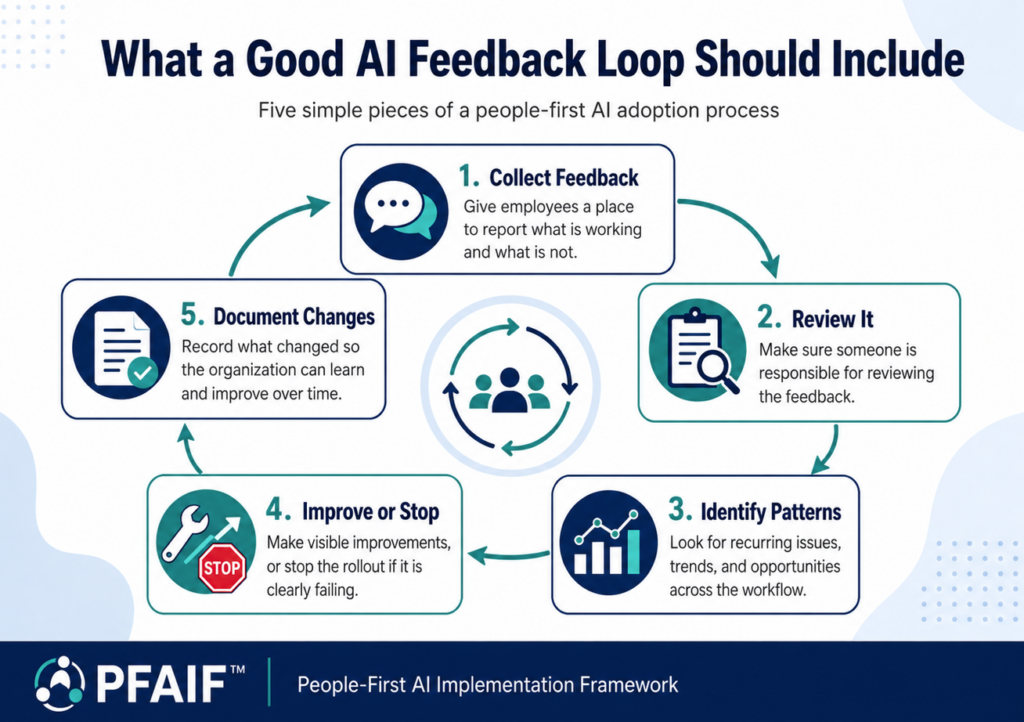
A good AI feedback loop should include five basic pieces.
- First, employees need a place to report what is working and what is not. This can be a form, shared document, Slack channel, Teams channel, weekly check-in, or manager conversation.
- Second, someone needs to review the feedback. Collecting feedback is not enough. If nobody looks at it, employees will stop participating.
- Third, the organization needs to identify patterns. One bad AI output may be a one-off issue. Ten similar complaints may mean the use case, prompt, input data, training, or workflow needs to change.
- Fourth, leaders need to make visible improvements. Employees should see that feedback leads to changes. Otherwise, feedback becomes performative.
- Fifth, the organization should document what changed. Updated prompts, examples, review checklists, approved use cases, prohibited uses, and training materials should be easy to find.
A feedback loop does not have to be complicated, but it does have to be real.
The worst version is asking employees for feedback and then doing nothing with it. That damages trust faster than never asking at all.
Example: Feedback Loops in a Home Services Company
A home services company may use AI to help with technician job notes, customer follow-up messages, review responses, and internal dispatch summaries.
At launch, the use case may seem clear. AI drafts follow-up messages after completed service visits. CSRs review the drafts before sending. Managers expect faster and more consistent communication.
After a few weeks, the team may notice patterns.
AI drafts are useful when technician notes are complete. They are weak when notes are vague. AI handles maintenance visits well but struggles with complex repairs. It sometimes creates messages that sound too polished for a frustrated customer. It occasionally suggests next steps that were not actually recommended by the technician. A feedback loop lets the company respond.
The company may update the technician note template, create a “do not use AI” rule for complaints, add a CSR review checklist, and build examples of good and bad AI-assisted messages. Managers may also review which job types produce the most editing work.
Without that feedback loop, the office team may quietly lose trust in the tool. With it, the AI process gets better.
Example: Feedback Loops in a Marketing Agency
A marketing agency may use AI for content outlines, keyword clustering, client research summaries, meta descriptions, reporting summaries, and first-draft support.
At first, leadership may see faster output and think adoption is working. But editors may notice that AI-assisted outlines are too generic. Writers may say the AI helps with structure but not client-specific insight. Account managers may find that AI summaries miss important client context. SEO strategists may see that AI keyword groupings look clean but do not always match search intent.
A feedback loop gives each role a way to report these issues.
The agency could create a monthly AI content review where writers, editors, strategists, and account managers discuss what is helping and what is creating rework. The team may decide that AI is useful for organizing research but not for drafting final recommendations. They may create stronger prompts for service-area businesses, add a local relevance checklist, or prohibit AI from inventing claims, statistics, testimonials, or case study details.
This kind of feedback loop protects quality.
It also protects morale. Writers and editors are more likely to accept AI when they see that leadership is not blindly chasing volume at the expense of quality.
Example: Feedback Loops in a Dental Office
A dental office may use AI to draft appointment preparation messages, routine reminders, internal checklists, and front desk communication.
At launch, the office may decide that AI can support routine administrative communication, but not diagnosis, treatment recommendations, clinical advice, or sensitive patient details. That is a good start.
But real use will still reveal issues.
Front desk staff may find that AI reminders are too long. Patients may still arrive without the right forms. Some messages may use language that sounds too clinical. Staff may be unsure how to handle questions about insurance, sedation, post-treatment instructions, or patient-specific concerns.
A feedback loop could include a short weekly check-in for the first month. Staff can flag confusing drafts, patient questions, and situations where AI should not be used. The office manager can update approved templates and examples based on what employees see.
This keeps the AI workflow safe and practical.
It also reminds employees that they are not expected to figure out the boundaries alone.
Example: Feedback Loops in a Law Firm
A law firm may use AI for internal document summaries, timeline organization, administrative drafts, or intake classification.
In this environment, feedback loops are especially important because the cost of overtrusting AI can be high.
Attorneys and paralegals may discover that AI summaries are useful for orientation but sometimes miss important details, overstate certainty, or fail to capture nuance. Intake staff may find that AI helps categorize inquiries but occasionally misclassifies urgency. Legal assistants may use AI to draft routine administrative emails but need clearer rules about confidentiality and review.
A feedback loop might include documented issue reporting, attorney review of sample outputs, updated guidance on approved use cases, and a monthly discussion of where AI created value or risk.
The firm may decide that AI is helpful for first-pass internal organization but should not be used for certain document types or client-facing work. That is not a failure. It is responsible implementation.
AI feedback loops help the firm keep the tool in its proper role.
Example: Feedback Loops in an Accounting Firm
An accounting firm may use AI during tax season to draft routine client messages, organize document requests, summarize internal notes, or explain common administrative items in plain language.
At first, this may feel like a major time saver. But during busy season, small problems become big quickly.
Staff may notice that AI-generated messages sound helpful but are too generic for certain clients. Some explanations may be accurate in general but not appropriate for a specific situation. Employees may spend extra time editing messages to avoid anything that sounds like personalized tax advice. Managers may realize that some staff are using AI carefully while others need more guidance.
A feedback loop allows the firm to refine the process.
The firm might build approved message templates, define which client questions require professional review, create examples of safe plain-language explanations, and track whether AI is reducing repetitive writing or creating more review work.
The goal is not to eliminate judgment.
The goal is to make routine work easier without weakening professional standards.
Example: Feedback Loops in a Restaurant Group
A restaurant group may use AI for review responses, social media captions, job descriptions, shift summaries, and internal communications.
After launch, managers may discover that AI works well for routine positive reviews but poorly for complaints. It may sound robotic. It may fail to address the specific customer concern. It may use phrasing that feels too formal for the brand. It may draft responses too quickly for sensitive situations that need careful human attention.
A feedback loop can help the group create better rules.
Managers can share examples of good AI-assisted responses and bad ones. The company can create a clear escalation list: food safety, injuries, discrimination, employee behavior, refunds, legal threats, and highly emotional complaints should be handled by a person, not casually drafted by AI.
The restaurant group can also update its brand voice examples so AI-assisted drafts sound more like the business.
This keeps AI useful without making the customer experience feel automated or careless.
Feedback Loops Help Employees Trust the Process
Employees are more likely to trust AI adoption when they see that feedback matters.
This does not mean every employee suggestion will be accepted. It means employees need to know their real-world experience is part of the rollout.
When employees report that AI output is wrong and leadership ignores it, trust drops. When employees say the tool creates extra work and leadership only responds with more pressure to use it, resistance grows. When employees ask for better examples and nothing changes, training loses credibility.
On the other hand, trust grows when employees see visible improvement.
A CSR reports that AI follow-up messages are weak for warranty issues, and the company narrows the use case. A writer says AI outlines are too generic, and the agency updates the prompt and review checklist. A paralegal flags missed details in AI summaries, and the firm adds a stricter review rule. A restaurant manager says AI review responses sound robotic, and the company updates brand voice examples.
These changes tell employees: “Your experience matters.”
That is the foundation of a people-first AI rollout.
Feedback Loops Prevent Silent Resistance
Not all AI resistance is loud.
In many organizations, employees do not openly push back. They simply stop using the tool. Or they use it only when required. Or they create workarounds. Or they fix AI mistakes quietly and never tell leadership. Or they comply in public while privately believing the tool is not helpful. This is called silent resistance. Feedback loops help leaders catch it early.
If employees are avoiding AI, leaders need to know why. Maybe the output is poor. Maybe the training was too generic. Maybe the use case is unclear. Maybe employees are worried about accountability. Maybe the workflow adds steps instead of removing them. Maybe people do not believe leadership wants honest feedback.
Without feedback loops, silent resistance looks like a mystery. With feedback loops, it becomes diagnosable.
Leaders can ask direct questions: Where is AI helping? Where is it slowing you down? What do you not trust? What do you have to fix? What would make this easier to use? Would you keep using it if it were optional? Those questions make hidden problems visible.
Feedback Loops Help Identify Hidden Rework
AI can make work look faster while quietly increasing rework.
This is one of the biggest reasons feedback loops are needed after launch.
For example, a salesperson may use AI to summarize calls faster, but account managers may later correct missed commitments. A technician may use AI to clean up job notes, but the office still has to call for missing details. A writer may use AI to draft content faster, but editors spend extra time removing generic sections. A manager may use AI to create reports, but the team has to correct misleading summaries.
If leaders only measure output volume, they may miss this.
Feedback loops should ask where AI creates correction work and who is doing that correction. The person who benefits from AI may not be the person paying the cleanup cost.
That matters because hidden rework destroys trust.
Employees will not keep supporting AI if they feel it only moves work from one person to another.
A good feedback loop measures whether AI improves the whole workflow, not just one task.
Feedback Loops Should Update Documentation
One of the most practical outputs of a feedback loop is better documentation.
As employees use AI, the organization should keep improving its guidance. That may include approved use cases, prohibited uses, prompt examples, review checklists, escalation rules, quality standards, training examples, and common mistakes.
Documentation should not be treated as a one-time PDF that nobody reads after launch.
It should become a living reference.
For example, after a pilot, a company may update its AI guide to say:
- AI may be used for routine maintenance follow-up messages.
- AI should not be used for warranty disputes, safety concerns, or complaints without manager review.
- CSRs must check job details, pricing language, recommendations, and tone before sending.
- Technician notes must include diagnosis, work performed, parts, and recommended next steps.
- Feedback should be submitted through the AI workflow form.
This kind of documentation turns lessons learned into better adoption. It also helps new employees understand the process later.
Feedback Loops Should Reinforce Good AI Use
Feedback loops are not only for catching problems. They should also reinforce what is working.
If an employee finds a strong way to use AI responsibly, the organization should document it and share it. If a team improves a workflow, that should become a model for others. If a prompt, checklist, or review process works well, it should be added to the approved guidance.
This is important because employees often learn from each other.
For example, one CSR may develop a strong review process for AI-assisted customer messages. One technician may create better job note structure. One editor may build a useful checklist for AI-assisted outlines. One manager may find a better way to use AI for meeting summaries without losing context.
Good feedback loops identify these wins and turn them into repeatable practices.
That does not mean rewarding people for using AI the most. High usage is not always good usage. The better goal is to reinforce AI use that improves the workflow, protects quality, and reduces unnecessary work.
Responsible AI adoption should reward judgment, not just activity.
Feedback Loops Help Leaders Decide What to Scale, Fix, or Stop
After launch, leaders need a way to make decisions.
A feedback loop can help classify AI use cases into three categories.
Some use cases should scale. They are useful, trusted, low-risk, and clearly improve the workflow.
Some use cases should be fixed. They have potential, but need better training, better inputs, clearer review rules, or a narrower scope.
Some use cases should stop. They do not create enough value, create too much risk, damage trust, or produce more rework than benefit.
This is healthy.
Not every AI use case deserves to survive. The goal is not to keep every experiment alive. The goal is to learn which AI uses are worth keeping.
For example, a marketing agency may stop using AI for full first drafts but continue using it for outlines and research organization. A restaurant group may scale AI for routine positive review responses but stop using it for complaint responses. A home services company may continue AI-assisted follow-up messages only for specific job types. A law firm may limit AI to internal summaries with stricter review.
That is not failure.
That is good governance.
How Often Should AI Feedback Loops Run?
The right timing depends on the workflow and risk level.
During a new pilot or rollout, feedback should be frequent. Weekly or biweekly check-ins can help leaders catch problems quickly. After the process stabilizes, monthly or quarterly reviews may be enough.
High-risk use cases should be reviewed more often. Anything involving customers, clients, legal work, medical information, financial advice, HR decisions, safety, compliance, or sensitive communication needs closer monitoring.
Low-risk use cases may need lighter review. Brainstorming, internal drafts, meeting agenda ideas, or low-stakes summaries may not require as much structure, but employees should still have a way to report issues.
A simple schedule could look like this:
Week 1: early check-in on confusion and obvious problems.
Week 2 to 4: collect feedback on output quality, review burden, and workflow fit.
End of pilot: decide whether to scale, revise, pause, or stop.
After launch: review monthly for the first quarter.
Ongoing: review quarterly or when the workflow changes.
The key is consistency.
A feedback loop only works if people know it exists and trust that it will continue.
What Leaders Should Ask After AI Launch
After an AI workflow launches, leaders should ask practical questions.
- Is the AI use case still clear?
- Are employees using it for the intended tasks?
- Are employees avoiding it in certain situations?
- Does the AI output meet quality standards?
- How much review is required?
- Does AI save time after review and correction are included?
- Does AI create extra cleanup work for another team?
- Do employees trust the output?
- Are customers, clients, or internal users seeing better results?
- What examples should be added to training?
- What should AI no longer be used for?
- What should be scaled?
- What should be stopped?
These questions help leaders stay connected to reality.
They also prevent AI adoption from becoming a slogan instead of a working process.
Create a Simple AI Feedback Loop Template
Leaders can use a simple template to manage post-launch feedback.
AI Use Case:
What workflow or task does this feedback apply to?
What Worked:
Where did AI help?
What Did Not Work:
Where did AI create problems?
Output Quality Issues:
Was anything inaccurate, incomplete, generic, off-brand, unsafe, or confusing?
Review Burden:
How much editing or correction was required?
Workflow Impact:
Did AI reduce friction or add steps?
Trust Level:
Do employees trust the output enough to keep using it?
Employee Suggestions:
What should be changed?
Customer or Client Impact:
Did the AI-assisted process affect the customer, client, patient, or user experience?
Decision:
Scale, revise, pause, or stop?
Documentation Update Needed:
What training, checklist, prompt, or policy should be updated?
This template is simple, but it forces the right conversation.
Feedback Loops and AI Governance
Feedback loops are not just adoption tools. They are also part of responsible AI governance.
Governance is often discussed in terms of policies, security, legal review, privacy, and compliance. Those are all important. But real AI governance also needs feedback from the people using the tool in daily work.
Employees are often the first to see when AI output is unreliable, when a workflow creates risk, when a customer message feels wrong, when a process encourages overreliance, or when a tool is being used outside its intended purpose.
A feedback loop gives the organization a practical warning system.
It helps leaders catch misuse, poor fit, quality problems, training gaps, and trust issues before they become larger failures.
This is why PFAIF treats reinforcement and feedback loops as part of readiness. The framework does not see AI adoption as finished when a tool is launched. It sees adoption as something that must be reinforced, reviewed, and improved over time. The PFAIF manuscript also frames AI implementation as a socio-technical and organizational readiness challenge rather than only a technology rollout.
How Feedback Loops Fit Into PFAIF
Reinforcement and Feedback Loops is the final readiness area in PFAIF, and that placement matters.
The earlier steps help the organization prepare. Workflow assessment identifies where AI might fit. Use case definition clarifies what AI is supposed to do. Change communication explains the rollout. Role-specific training prepares employees. Quality standards define what good AI-assisted work looks like. Pilot testing checks the use case before broad rollout. Adoption and trust measurement shows whether people are using and trusting the process.
Feedback loops then keep the system alive after launch.
They turn AI adoption into an improvement cycle.
If the workflow changes, the AI process should change. If employees discover better practices, documentation should change. If trust is low, training or communication should change. If AI output creates rework, quality standards should change. If the use case does not show enough value, leaders should change or stop it.
Practical Checklist: AI Feedback Loops After Launch
After launching an AI use case, leaders should be able to answer these questions:
- Do employees have a clear way to report AI problems?
- Is someone responsible for reviewing feedback?
- Are employee concerns being grouped into patterns?
- Are AI workflows reviewed after implementation?
- Is employee feedback used to improve AI-related processes?
- Are effective AI uses documented and reinforced?
- Are AI processes updated when work needs change?
- Are leaders tracking whether AI creates extra correction work?
- Are employees told what changed because of their feedback?
- Are weak AI use cases revised, narrowed, paused, or stopped?
- Are training materials updated based on real use?
- Are managers reinforcing responsible use, not just more use?
If these questions cannot be answered, the organization may have launched AI, but it has not built a mature adoption system.
Common Mistakes With AI Feedback Loops
- The first mistake is not having one. Many companies launch AI and assume employees will speak up if something is wrong. That is not a strategy.
- The second mistake is collecting feedback but not acting on it. Employees quickly notice when feedback disappears into a black hole.
- The third mistake is listening only to AI enthusiasts. Power users can provide useful ideas, but leaders also need to hear from cautious employees, reviewers, managers, and people who inherit AI-created work.
- The fourth mistake is measuring only positive stories. Leaders need to know where AI fails, where it creates rework, and where employees do not trust it.
- The fifth mistake is failing to update documentation. If lessons learned are not captured, each team repeats the same mistakes.
- The sixth mistake is rewarding usage instead of responsible use. The goal is not to use AI more. The goal is to use AI better.
- The seventh mistake is refusing to stop weak use cases. Some AI workflows are not worth keeping. A strong feedback loop should make that visible.
AI adoption needs feedback loops because real implementation begins after launch. That is when employees discover whether AI actually helps the workflow. That is when quality issues appear. That is when trust grows or fades. That is when leaders learn whether the tool is reducing work or just moving cleanup to someone else.
A good feedback loop gives the organization a way to keep improving. It helps leaders listen to employees, update training, refine use cases, strengthen quality standards, measure trust, document what works, and stop what does not.
For business leaders, the lesson is simple: do not treat AI rollout as the finish line. Treat it as the start of the learning cycle. That is how AI adoption becomes useful, trusted, and sustainable.
Take the PFAIF Readiness Assessment
The PFAIF Readiness Assessment helps organizations evaluate people-first AI readiness across workflow assessment, use case definition, change communication, role-specific training, quality standards, pilot testing, adoption and trust measurement, and feedback loops.
Use it to identify where your organization is strongest and where more support may be needed before scaling AI.
Take the PFAIF Readiness Assessment
Learn more about the People-First AI Implementation Framework
Watch the recorded PFAIF webinar
FAQ
Why does AI adoption need feedback loops after launch?
AI adoption needs feedback loops after launch because employees discover real workflow issues, quality problems, trust concerns, and training gaps only after AI enters daily work. Feedback loops help leaders improve the process instead of assuming launch means success.
What is an AI feedback loop?
An AI feedback loop is a structured process for collecting employee feedback, reviewing AI workflow issues, identifying patterns, updating training or documentation, and improving or stopping AI use cases based on real-world experience.
What should leaders ask after an AI rollout?
After an AI rollout, leaders should ask whether employees trust the output, whether AI saves time after review, whether it creates extra cleanup work, whether quality standards are working, whether the use case is still clear, and what needs to change.
How do feedback loops improve employee trust in AI?
Feedback loops improve employee trust by showing employees that leadership listens to real-world concerns and acts on them. When employees see their feedback lead to better training, clearer rules, or improved workflows, they are more likely to trust the process.
What are examples of AI feedback loops?
Examples include weekly pilot check-ins, employee feedback forms, manager review meetings, shared issue logs, updated prompt libraries, revised quality checklists, role-specific training updates, and formal decisions to scale, revise, pause, or stop AI use cases.
How do feedback loops fit into PFAIF?
In the People-First AI Implementation Framework, Reinforcement and Feedback Loops is one of the eight readiness areas. It focuses on reviewing AI workflows after implementation, using employee feedback to improve AI processes, reinforcing effective use, updating processes as work changes, and treating AI adoption as an ongoing change process.