Employee trust in AI can be measured by asking whether employees believe AI tools are useful, reliable, accurate enough for their tasks, worth using after review, and supported by clear training, quality standards, and leadership expectations. Leaders should not measure AI adoption only through logins, licenses, or tool usage. They should also measure whether employees trust the output, understand when to use AI, know how to review it, and feel that AI improves work instead of creating extra cleanup. In the People-First AI Implementation Framework, or PFAIF™, adoption and trust measurement is one of the core readiness areas because AI adoption is weak if employees use the tool but do not trust it.
This is one of the most important parts of workplace AI implementation.
A company can buy AI tools, train employees, run pilots, and still misunderstand whether adoption is actually working. On the surface, everything may look fine. Employees may have accounts. Usage numbers may show activity. A few people may be producing more drafts, summaries, reports, or automations.
But underneath that activity, employees may not trust the tool.
They may use AI only because leadership told them to. They may avoid it for important work. They may quietly double-check everything because they assume the output is unreliable. They may spend more time fixing AI mistakes than they save. They may believe leadership cares more about AI usage than quality, judgment, or employee experience.
That is why leaders need to measure trust directly.
The PFAIF Readiness Assessment includes specific adoption and trust measurement items focused on whether organizations measure actual AI use, employee trust, time savings, added work, and usefulness rather than tool access alone.
Why Employee Trust in AI Is Critically Important
Trust is what turns AI access into real adoption.
If employees do not trust an AI tool, they will find ways around it. They may avoid using it. They may use it only for low-stakes tasks. They may comply during training but return to old habits later. They may produce AI-assisted work but feel uneasy about the quality. They may hesitate to tell leadership that the tool is not helping.
This is especially true when AI touches work that employees care about. People may feel comfortable using AI to brainstorm a subject line or summarize a meeting. They may feel much less comfortable using it for customer messages, client recommendations, legal summaries, performance reviews, safety information, patient communication, financial explanations, or anything that could create real consequences.
That does not mean employees are anti-AI. It means they are using judgment. Leaders should want that.
Blind trust in AI is not the goal. Useful trust is the goal. Employees should trust AI enough to use it when it fits the work, but not so much that they stop reviewing outputs, checking facts, or applying professional judgment.
A healthy AI culture does not say, “Trust the tool.” It says, “Use the tool where it helps, verify what matters, and tell us when it fails.”
Usage Is Not the Same as Trust!
One of the biggest mistakes leaders make is confusing AI usage with AI trust.
Usage metrics can be helpful, but they do not tell the whole story. A dashboard might show that employees logged into the tool, used prompts, generated summaries, or created drafts. That does not mean they believe the tool is useful. It does not mean they trust the output. It does not mean AI improved the workflow.
For example, a customer service team may use AI to draft follow-up emails because management expects it. The usage numbers may look strong. But if every CSR has to rewrite most of the draft before sending it, trust may be low.
A marketing agency may see that writers are using AI every day. But if editors are spending extra time removing generic sections, fixing unsupported claims, and adding client-specific insight, the workflow may not be improving.
A law firm may see that attorneys are using AI for internal summaries. But if attorneys still have to review every detail from scratch because they do not trust the summaries, the tool may be creating the appearance of efficiency without real value.
Usage tells you whether people touched the tool. Trust tells you whether the tool is becoming useful in real work. Leaders need both.
What Employee Trust in AI Actually Means
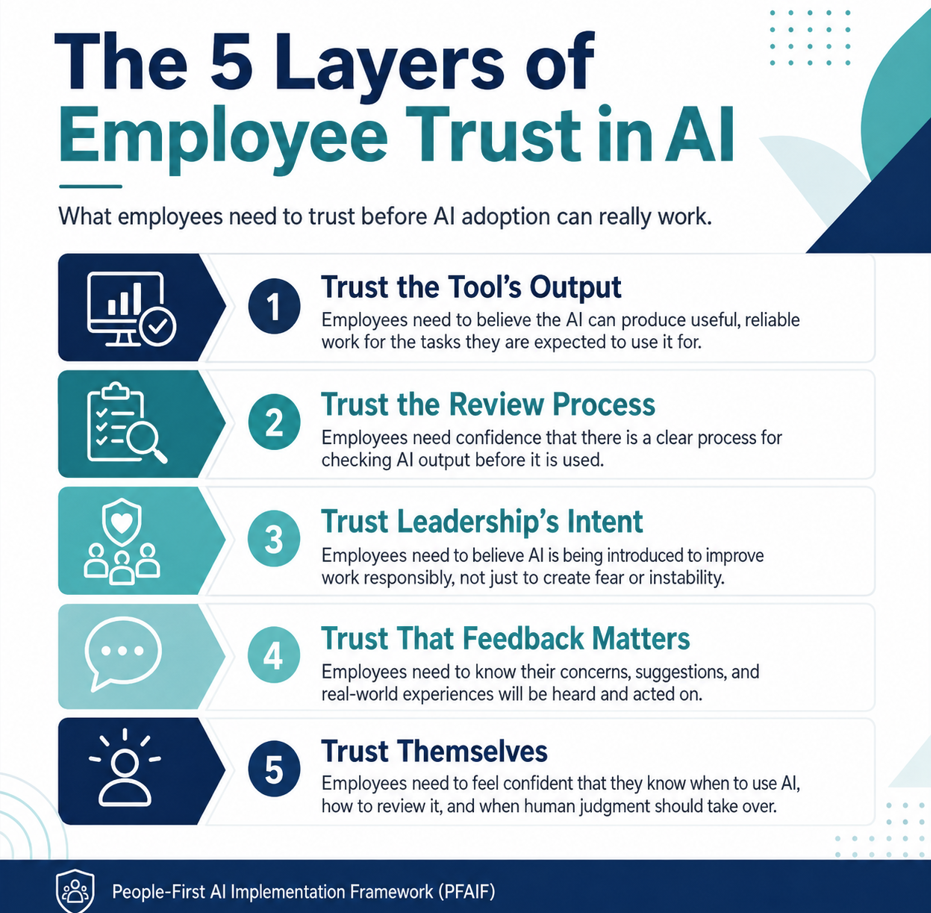
Employee trust in AI is not one simple thing. It usually includes several layers.
- First, employees need to trust the tool’s output. They need to believe that AI can produce useful work for the task at hand. Not perfect work. Useful work.
- Second, employees need to trust the review process. They need to know what must be checked, who owns the final output, and what standard applies before AI-assisted work is used.
- Third, employees need to trust leadership’s intent. If employees believe AI is mainly being introduced to cut jobs, monitor them, or squeeze more output from the same staff, adoption will be fragile.
- Fourth, employees need to trust that feedback matters. If they report problems and nothing changes, trust drops.
- Fifth, employees need to trust themselves. This is often overlooked. Employees may avoid AI because they are not confident they know how to use it correctly, review the output, or avoid mistakes.
When measuring AI trust, leaders should not only ask, “Do employees trust AI?” They should ask what kind of trust is missing.
A team may trust AI for brainstorming but not for customer communication. A technician may trust AI to clean up note formatting but not to summarize technical recommendations. A writer may trust AI for outline ideas but not for final copy. A manager may trust AI for organizing meeting notes but not for evaluating employee performance. That nuance matters.
The Main Questions to Ask Employees About AI Trust
The best way to measure employee trust in AI is to ask practical questions tied to real work.
Here are useful questions leaders can ask:
- Do you trust AI output for the tasks you are expected to use it for?
- Do you know which AI use cases are approved for your role?
- Do you understand when AI should not be used?
- Do you know how to review AI output before using it?
- Does AI save time after review and correction are included?
- Does AI make your work better, or just faster?
- Does AI create extra cleanup work for you or someone else?
- Do you feel comfortable telling your manager when AI output is wrong?
- Do you believe leadership is listening to employee feedback about AI?
- Would you keep using this AI workflow if it were optional?
That last question is especially useful. If employees would stop using the tool the moment it became optional, the adoption may not be healthy.
The point is not to pressure employees into positive answers. The point is to learn what is really happening before weak trust turns into silent resistance.
Use Surveys, But Keep Them Practical
A short employee AI trust survey can be very useful, especially after a pilot or early rollout.
The survey should be simple enough that employees will complete it honestly. It should not feel like a corporate compliance exercise. A good survey might ask employees to rate statements on a 1 to 5 scale.
For example:
- I understand when I am expected to use AI in my role.
- I understand when AI should not be used.
- I trust AI output for the tasks I am expected to use it for.
- I know how to review AI output before using it.
- AI helps me complete work more effectively.
- AI saves time after review and correction are included.
- AI creates extra work that reduces its value.
- I feel comfortable reporting problems with AI output.
- Leadership communicates clearly about how AI should be used.
- Employee feedback is used to improve AI workflows.
These questions give leaders a clearer picture than usage metrics alone.
They also align with the broader PFAIF logic that AI success should be measured by usefulness, trust, time savings, correction burden, and whether the organization improves the process after launch. The PFAIF outcome items also include employee trust, willingness to use AI when it fits the work, correction burden, and leadership-employee alignment as relevant adoption outcomes.
Ask Open-Ended Questions Too
Numbers are useful, but open-ended questions often explain why employees feel the way they do.
A survey score might show that trust is low. An open-ended response tells you why.
Leaders should ask questions like:
- What makes you hesitant to use AI in your work?
- Where has AI helped you so far?
- Where has AI created extra work?
- What kind of AI output do you not trust?
- What would make you more comfortable using AI?
- What training, examples, or standards would help?
- What should leadership understand about how AI is affecting your work?
These responses may reveal patterns that leaders would not see in a dashboard.
For example, employees may say they do not trust AI because the tool makes up details, because the training was too generic, because managers still expect perfect output, because the workflow is unclear, or because AI creates more work for the next person in the process. That kind of feedback is implementation gold.
A small business owner may discover that employees are not resisting AI itself. They are resisting a messy rollout. A manager may discover that trust is low because employees do not know who is responsible when AI makes a mistake. A consultant may discover that employees like the tool but hate the workflow around it.
Open-ended feedback helps leaders fix the real problem.
Example: Measuring AI Trust in a Home Services Company
Imagine a home services company using AI to draft customer follow-up messages after completed service visits.
Leadership may start by checking usage. Are CSRs using the AI draft tool? How many messages are generated? How many are sent?
That is useful, but not enough.
The company should also ask CSRs whether they trust the drafts. Are the messages accurate? Do they match the technician notes? Do they include the right service details? Do they avoid incorrect warranty or pricing language? Do they save time after editing? Are some job types better suited for AI than others?
The company may discover that CSRs trust AI for routine maintenance follow-ups but not for complicated repair visits, angry customers, warranty issues, or jobs with incomplete technician notes.
That is a strong finding. It gives leadership a practical next step. The company can narrow the use case, improve technician note templates, create a review checklist, and train CSRs on when to use AI and when to write manually.
Without trust measurement, leadership might only see that the tool is being used.
With trust measurement, leadership sees where the tool is actually useful.
Example: Measuring AI Trust in a Marketing Agency
A marketing agency may use AI to support content planning, outlines, research summaries, meta descriptions, and first drafts.
Usage may be high because marketing teams tend to experiment with tools quickly. But trust may vary by role.
Writers may trust AI for outline ideas but not for final content. Editors may trust AI for structure but not for accuracy. SEO strategists may trust AI for brainstorming keyword groupings but not for final search intent decisions. Account managers may trust AI summaries for meeting notes but still worry that important client context gets missed.
The agency should measure trust at the task level.
Instead of asking, “Do you trust AI?” the agency should ask:
- Which AI-assisted tasks are useful?
- Which outputs require too much editing?
- Where does AI produce generic work?
- Where does AI miss client-specific details?
- Where does AI improve speed without lowering quality?
- Where does AI create more work for editors?
The answers may show that AI is useful in planning but harmful when used for full drafts. Or it may show that AI works well for certain content types but not others.
That lets the agency build smarter standards instead of making a blanket rule like “use AI more” or “do not use AI.”
Example: Measuring AI Trust in a Dental Office
A dental office may use AI for routine appointment reminders, patient preparation messages, internal checklists, and front desk communication.
Employee trust should be measured carefully because patient communication can become sensitive.
The office might ask front desk staff whether AI-generated reminders are clear, accurate, and easy to review. It might ask whether employees know what information should not be entered into AI tools. It might ask whether employees understand that AI should not be used for diagnosis, treatment recommendations, or personalized clinical advice.
The office should also ask whether the AI workflow actually helps. Does it reduce repetitive writing? Do patients arrive better prepared? Are staff spending less time correcting messages? Are employees confident in the review process?
The goal is not to make the dental team trust AI for everything.
The goal is to identify the narrow areas where AI can safely support routine work.
Trust measurement helps keep that boundary clear.
Example: Measuring AI Trust in a Law Firm
A law firm may use AI for internal document summaries, research organization, timeline building, or administrative drafts.
In this setting, trust measurement should be specific and cautious.
Attorneys and paralegals may be asked whether AI summaries help them understand documents faster, but also whether the summaries miss important details, overstate conclusions, or create false confidence. The firm should measure whether AI output saves time after verification is included.
A good trust survey for a law firm might ask:
- Do you trust AI summaries as a first-pass support tool?
- Do you know what must be verified before relying on a summary?
- Have you seen AI output miss or distort important information?
- Do you understand what information can and cannot be entered into the tool?
- Do you feel pressure to use AI even when it may not fit the task?
- Do you know who is accountable for final work?
In a law firm, low trust may be appropriate for certain uses. That is not necessarily a failure. It may simply mean the use case requires tighter limits, better review, or a different tool.
Trust measurement should not push people toward blind confidence.
It should help the firm find the right level of reliance.
Example: Measuring AI Trust in an Accounting Firm
An accounting firm may use AI to draft routine client messages, summarize meetings, organize document requests, or translate technical language into plain English.
During tax season, employees may appreciate anything that reduces repetitive communication. But they may not trust AI with client-specific questions or anything that sounds like tax advice.
The firm should measure where employees draw that line.
Staff may trust AI to draft a basic reminder asking a client for missing documents. They may not trust it to explain how a tax rule applies to a specific client. They may trust it to organize meeting notes but not to recommend a filing position. That distinction is healthy.
The firm can measure employee trust by asking whether AI outputs are clear, accurate, useful, easy to review, and properly limited. It should also ask whether AI creates extra correction work during the busiest parts of the year.
If staff say AI helps with routine explanations but slows them down on complex client questions, the firm should not treat that as resistance. It should treat it as good implementation intelligence.
Example: Measuring AI Trust in a Restaurant Group
A restaurant group may use AI to respond to reviews, draft social media posts, summarize shift notes, or write job descriptions.
Trust measurement should focus on tone, accuracy, and escalation.
A manager may trust AI to draft responses to routine positive reviews. They may not trust AI for complaints about food safety, discrimination, injuries, refunds, employee conduct, or legal threats.
That boundary should be measured and respected.
Leaders can ask managers:
- Which review types are safe for AI-assisted drafts?
- Which review types should always be human-led?
- Do AI drafts sound like our brand?
- Do they feel too robotic?
- Do they address the customer’s actual concern?
- Do they save time after editing?
- Do managers feel comfortable rejecting AI drafts?
The last question matters. Employees should not feel like they have to use AI output just because it exists.
In customer-facing industries, trust is not just about whether employees trust the tool. It is also about whether the customer will trust the business after seeing AI-assisted communication.
Measure Trust by Role, Not Just Company-Wide
Company-wide trust scores can hide important differences.
One department may trust AI because their use case is simple and low-risk. Another team may distrust AI because their use case is sensitive or poorly defined. One location may have strong managers and good training. Another may have confusion and weak feedback loops.
If leaders only look at an overall trust score, they may miss the real problem.
Trust should be measured by role, team, location, workflow, and use case whenever possible.
For example, a home services company may find that CSRs trust AI follow-up drafts, but technicians do not trust AI-assisted note formatting because it misinterprets technical details. A marketing agency may find that writers trust AI for brainstorming but editors distrust AI-generated drafts. A consulting firm may find that junior analysts use AI heavily, while senior consultants worry about quality and client risk.
These differences are not bad. They help leaders understand where support is needed.
PFAIF treats the eight readiness areas as diagnostic categories, meaning they are useful for identifying where implementation support is weaker even while the broader assessment is strongest as an overall readiness index.
Track Rework as a Trust Signal
Rework is one of the clearest signs that AI trust may be weaker than leadership thinks.
If employees have to constantly fix AI output, they will stop trusting it. If one team uses AI and another team cleans up the mistakes, trust can break down across departments.
Leaders should track whether AI is creating extra work.
This can be done through simple questions:
- How often do AI outputs need major edits?
- How often does AI miss important information?
- How often does AI create customer, client, or internal confusion?
- How much time is spent reviewing and correcting AI output?
- Which use cases create the most cleanup work?
- Who is doing the cleanup?
That last question is especially important.
Sometimes AI makes one person faster while making another person slower. For example, a salesperson may use AI to generate quick call summaries, but account managers may spend extra time correcting missed commitments. A technician may use AI to clean up notes, but the office may still have to clarify missing details. A writer may use AI to draft faster, but the editor may spend longer fixing generic work.
If AI shifts work downstream, trust will drop.
Rework is not just an efficiency metric. It is a trust metric.
Measure Whether Employees Feel Safe Reporting AI Problems
Employees may not tell the truth about AI if they think leadership already decided the tool is a success.
This is common. A company introduces AI with a lot of excitement. Leaders talk about productivity gains. Managers encourage adoption. Employees quickly learn that positive feedback is welcome and negative feedback may be viewed as resistance.
That is dangerous.
If employees do not feel safe reporting AI problems, leadership will not see the real implementation issues until they become expensive.
Trust measurement should include psychological safety around feedback.
Leaders should ask:
- Do you feel comfortable telling your manager when AI output is wrong?
- Do you feel comfortable saying a use case is not working?
- Do you believe leadership will act on AI feedback?
- Are employees rewarded only for using AI, or also for using judgment?
- Have you ever avoided reporting an AI issue because you did not want to seem negative?
- These questions may feel uncomfortable, but they are important.
A healthy AI rollout needs employees who are willing to say, “This output is wrong,” “This workflow does not help,” or “This creates more work than it saves.”
That is not resistance. That is quality control.
Measure Trust Before and After a Pilot
Trust should not be measured only after a broad rollout. It should be measured before and after a pilot.
Before the pilot, leaders should understand employee expectations and concerns. Are employees worried about job security? Do they understand the use case? Do they trust the tool at all? Do they know what will remain human-led?
After the pilot, leaders should measure whether trust improved, declined, or stayed the same.
For example, before a pilot, employees may feel skeptical because they have never used the tool. After a well-designed pilot with good training and clear quality standards, trust may improve. That is a good sign.
But the opposite can happen too. Employees may begin the pilot with curiosity and leave with lower trust because the AI output was poor, the workflow was clunky, or leadership ignored feedback.
That is also useful information.
A pilot should not be judged only by whether AI technically worked. It should be judged by whether employees trust the process enough to continue.
Combine Quantitative and Qualitative Trust Signals
The best AI trust measurement combines numbers and stories.
Quantitative measures help leaders see patterns. Survey scores, usage rates, time saved, correction rates, and adoption by role can show whether trust is improving or weakening.
Qualitative feedback explains what those numbers mean. Employee comments, interviews, team discussions, and open-ended survey responses reveal the reasons behind trust or distrust.
For example, a survey may show low trust in AI-generated customer messages. Comments may reveal that the issue is not the AI tool itself. The problem is incomplete technician notes, unclear review rules, or fear of sending inaccurate warranty information.
A survey may show high usage but low usefulness. Comments may reveal that employees use AI because leadership expects it, but they do not believe it improves the work.
A survey may show trust is higher in one department than another. Comments may reveal that the stronger department received better role-specific training.
Numbers show where to look. Comments explain what to fix.
What Leaders Should Do When Trust Is Low
Low AI trust is not always bad news. It is a signal.
If employees do not trust AI, leaders should not respond by pushing harder. Forced adoption may increase compliance, but it usually does not create real trust.
Instead, leaders should diagnose the reason.
- If employees do not trust the output, improve quality standards, narrow the use case, or strengthen review.
- If employees do not trust the workflow, map the process again and remove extra steps.
- If employees do not trust leadership’s intent, communicate more clearly and address concerns honestly.
- If employees do not trust themselves, provide role-specific training and guided practice.
- If employees do not trust that feedback matters, create visible changes based on employee input.
For example, if a pilot shows that employees distrust AI because it creates too many inaccurate customer drafts, the solution is not to tell employees to “get comfortable with AI.” The solution may be to improve inputs, revise prompts, change the use case, add review standards, or stop using AI for that task.
Trust is earned through better implementation.
Not slogans.
Warning Signs That AI Trust Is Weak
Leaders should watch for signs that employees do not trust AI, even when they are not saying it directly.
Common warning signs include:
- Employees use AI only when watched or required.
- Employees avoid AI for important work.
- Employees create their own unofficial AI workarounds.
- Employees spend a lot of time checking or rewriting AI output.
- Managers receive more complaints about quality.
- One team’s AI use creates more work for another team.
- Employees joke negatively about the tool.
- People stop giving feedback because they think nothing will change.
- AI use remains high during training but drops afterward.
- Employees ask the same basic questions weeks after rollout.
These signs do not mean AI adoption is doomed. They mean leadership needs to investigate.
The earlier leaders notice weak trust, the easier it is to fix.
How Often Should Employee AI Trust Be Measured?
Trust should be measured at multiple points.
- Before an AI pilot, measure expectations and concerns.
- During the pilot, collect quick feedback weekly or biweekly.
- At the end of the pilot, measure usefulness, trust, review burden, and willingness to continue.
- After rollout, measure trust again after 30, 60, or 90 days.
For ongoing AI workflows, measure trust periodically. Quarterly may be enough for stable use cases. More frequent check-ins may be needed when the tool, workflow, team, or risk level changes.
The key is to avoid treating trust measurement as a one-time survey.
AI tools change. Workflows change. Employee confidence changes. Leadership expectations change. A use case that worked well at first may become less useful later. A use case that seemed weak may improve after better training and standards.
Trust should be monitored as part of ongoing implementation.
How Employee Trust Measurement Fits Into PFAIF
In PFAIF, Adoption and Trust Measurement comes after workflow assessment, use case definition, communication, training, quality standards, and pilot testing.
That order matters.
Employees are more likely to trust AI when the workflow is clear, the use case is specific, communication is honest, training is role-specific, quality standards are defined, and pilot testing includes real feedback. If those earlier steps are weak, trust measurement will often reveal the damage.
PFAIF treats trust as something leaders should measure, not assume. That is important because leaders may have a very different view of AI adoption than employees do. Leadership may see tool access, usage dashboards, or pilot activity. Employees may see confusing workflows, weak output, unclear accountability, or extra cleanup work.
Trust measurement closes that gap.
It helps leaders see whether AI is becoming useful, trusted, and sustainable in the actual workplace.
Practical Checklist: Measuring Employee Trust in AI
Before deciding that AI adoption is working, leaders should be able to answer these questions:
- Do employees understand the approved AI use cases for their role?
- Do employees trust AI output for those use cases?
- Do employees know how to review AI output?
- Do employees know when AI should not be used?
- Does AI save time after review and correction are included?
- Does AI improve work quality?
- Does AI create extra cleanup work?
- Do employees feel safe reporting AI problems?
- Are employees willing to keep using AI when it fits the work?
- Do managers know where employees trust AI and where they do not?
- Is feedback being used to improve the AI workflow?
- Are trust levels being measured over time?
If leaders cannot answer these questions, they do not really know whether AI adoption is working.
They only know whether AI is available.
A Simple Employee AI Trust Survey Template
Here is a simple survey leaders can adapt for a pilot or rollout.
Use a 1 to 5 scale where 1 means strongly disagree and 5 means strongly agree.
I understand when I am expected to use AI in my role.
I understand when AI should not be used.
I trust AI output for the tasks I am expected to use it for.
I know how to review AI output before using it.
AI helps me complete work more effectively.
AI saves time after review and correction are included.
AI improves the quality or consistency of my work.
AI creates extra cleanup work for me or others.
I feel comfortable reporting problems with AI output.
Leadership communicates clearly about AI expectations.
Employee feedback is used to improve AI workflows.
I would continue using this AI workflow if it were optional.
Add two open-ended questions:
Where is AI helping you most?
What would make you trust AI more in your work?
This is simple enough for most businesses to use, but detailed enough to reveal whether adoption is healthy.
Common Mistakes When Measuring Employee Trust in AI
- The first mistake is measuring only usage. Usage matters, but it does not prove trust or value.
- The second mistake is asking questions that are too broad. “Do you trust AI?” is less useful than asking whether employees trust AI for a specific task.
- The third mistake is ignoring rework. If AI saves time in one place but creates cleanup work somewhere else, trust will suffer.
- The fourth mistake is failing to measure psychological safety. Employees need to feel safe reporting AI problems.
- The fifth mistake is measuring trust only after rollout. Trust should be measured before, during, and after pilots.
- The sixth mistake is treating low trust as employee resistance. Low trust may be a rational response to poor output, unclear expectations, weak training, or messy workflows.
- The seventh mistake is collecting feedback and doing nothing with it. Nothing damages trust faster than asking for input and ignoring it.
Employee trust in AI should not be assumed. It should be measured. Leaders need to know whether employees trust AI output, understand how to review it, believe it improves the work, and feel safe reporting problems. They also need to know whether AI is saving time after correction work is included or simply shifting work to someone else.
The goal is not blind trust. The goal is responsible trust.
Employees should trust AI enough to use it where it helps, but they should also have the training, judgment, and support to challenge it when it is wrong. That is how AI adoption becomes useful, trusted, and sustainable.
Take the PFAIF Readiness Assessment
The PFAIF Readiness Assessment helps organizations evaluate people-first AI readiness across workflow assessment, use case definition, change communication, role-specific training, quality standards, pilot testing, adoption and trust measurement, and feedback loops.
Use it to identify where your organization is strongest and where more support may be needed before scaling AI.
Take the PFAIF Readiness Assessment
Learn more about the People-First AI Implementation Framework
Watch the recorded PFAIF webinar
FAQ
How do you measure employee trust in AI?
You measure employee trust in AI by asking whether employees trust AI output for specific tasks, understand when to use AI, know how to review the output, believe AI improves their work, feel safe reporting problems, and would continue using the AI workflow if it were optional.
Why is AI usage not enough to measure adoption?
AI usage is not enough because employees may use AI only because they are required to. Usage does not prove that employees trust the tool, find it useful, save time after review, or believe it improves work quality.
What questions should leaders ask about employee trust in AI?
Leaders should ask whether employees trust AI output, know when AI should not be used, understand review expectations, believe AI saves time after correction work, feel safe reporting problems, and think employee feedback is used to improve AI workflows.
What is a good employee AI trust survey?
A good employee AI trust survey includes practical role-based questions about approved use cases, output trust, review confidence, time savings, correction work, psychological safety, leadership communication, feedback loops, and willingness to keep using AI when it fits the work.
What are signs employees do not trust AI?
Signs employees do not trust AI include avoiding the tool, using it only when required, heavily rewriting outputs, creating unofficial workarounds, joking negatively about the tool, avoiding important use cases, or reporting that AI creates more cleanup work than value.
How does trust measurement fit into PFAIF?
In the People-First AI Implementation Framework, Adoption and Trust Measurement is one of the eight readiness areas. It focuses on whether organizations measure actual AI use, employee trust, time savings, added work, and usefulness rather than relying only on tool access.