AI pilot testing should come before broad rollout because it gives leaders a controlled way to test whether an AI use case actually works in the real workflow before the entire organization is expected to adopt it. A good AI pilot helps identify workflow problems, training gaps, quality issues, employee trust concerns, hidden rework, and unclear success measures before those problems become expensive at scale. In the People-First AI Implementation Framework, or PFAIF™, pilot testing is one of the core readiness areas because responsible AI adoption should be tested with real users before it becomes a company-wide expectation.
Many businesses want to move fast with AI. That is understandable. AI tools are improving quickly, competitors are experimenting, and leadership teams do not want to fall behind. But speed can create a false sense of progress. Buying the tool is not the same as implementing it. Giving everyone access is not the same as adoption. Asking employees to “start using AI” is not the same as building a reliable process.
A pilot helps slow the rollout down just enough to learn.
That does not mean getting stuck in endless planning. It means testing one use case with the right people, in the right workflow, with clear review standards, feedback, and success criteria. The goal is not to make AI adoption slower. The goal is to make it safer, smarter, and more likely to work.
The PFAIF Readiness Assessment includes pilot testing items that focus on limited-group testing, including actual users in the pilot, collecting feedback before expansion, revising AI use cases when problems appear, and being willing to stop a use case when it does not show enough value.
Why AI Rollouts Go Wrong Without a Pilot Test
AI rollouts often go wrong because leaders assume the tool will work in the real business the same way it worked in the demo.
A vendor demo usually shows clean inputs, clear tasks, ideal users, and polished outputs. Real work is messier. Customer information may be incomplete. Employees may use different wording. Data may live in multiple systems. Managers may have different expectations. Some employees may trust the tool quickly, while others may avoid it. AI output may look good at first but create problems later. A company-wide rollout exposes all of those issues at once.
For example, imagine a home services company buys an AI tool to summarize customer calls and push notes into the CRM. In the demo, the summaries look clean. Leadership approves the rollout across all locations. Within a few weeks, problems appear. Some summaries miss urgent details. Some CSRs do not trust the notes. Managers are unsure who should check them. Dispatchers complain that the summaries are formatted nicely but not actually useful. The company now has a messy adoption problem across the whole operation.
A pilot would have caught many of those issues earlier.
The company could have tested the tool with one team, reviewed the summaries, asked employees what was missing, adjusted the process, and decided whether the use case was ready to expand.
Without a pilot, the company learns the hard way.
A Pilot Is Not Just a Small Rollout
A common mistake is thinking that a pilot simply means “give the tool to fewer people.” That is not enough.
A real AI pilot is a structured test. It should answer specific questions before broader rollout. Does the AI use case solve the problem it was supposed to solve? Does it fit the workflow? Do employees understand how to use it? Is the output good enough after review? Does it save time or create more cleanup work? Do employees trust it enough to keep using it? What needs to change before expansion?
A small rollout without structure can still fail. If leaders give five employees access to a tool and say, “Try this and let us know what you think,” they may get random feedback. One person may use it heavily. Another may ignore it. Another may use it in a way leadership did not intend. The company may still not know whether the use case is working.
A good pilot needs a defined use case, a defined group, a defined workflow, defined quality standards, a defined feedback process, and a decision point at the end.
The pilot should not be vague experimentation. It should be a learning process.
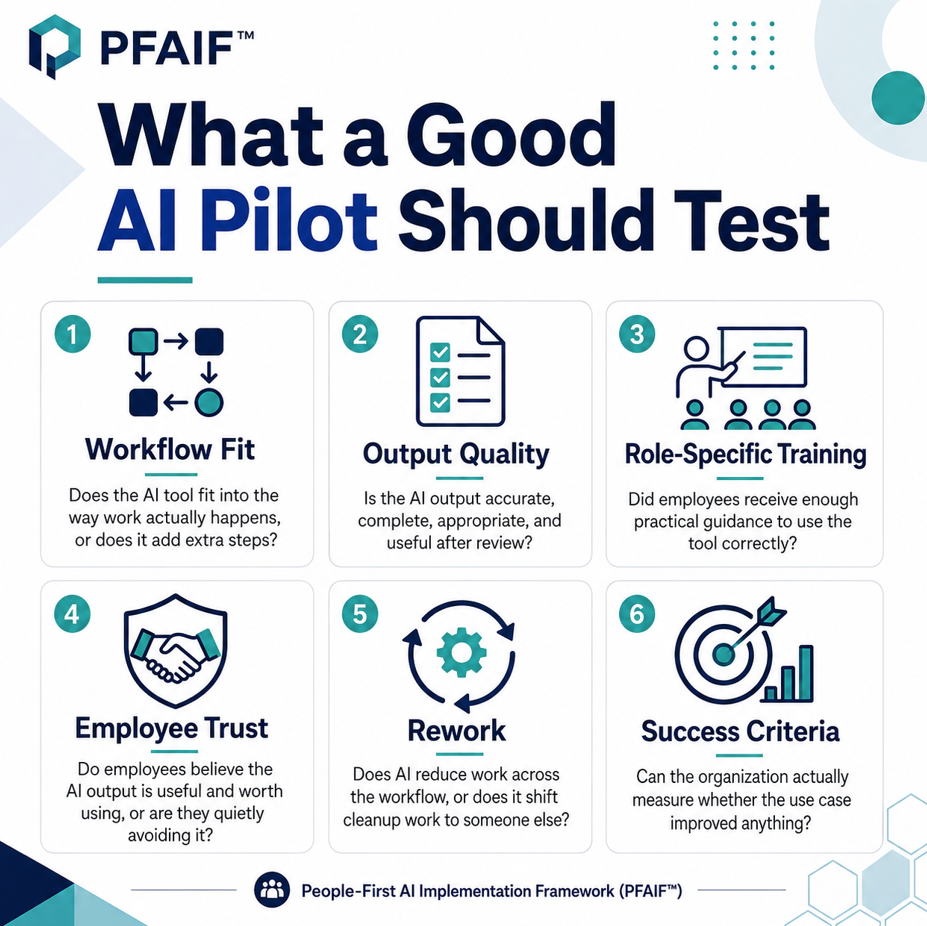
What a Good AI Pilot Should Test
A good AI pilot should test more than whether the tool technically works.
The technical part matters, but implementation usually succeeds or fails around the people and workflow surrounding the tool.
A strong pilot should test at least six things.
- First, it should test workflow fit. Does the AI tool fit into the way work actually happens, or does it add extra steps?
- Second, it should test output quality. Is the AI output accurate, complete, appropriate, and useful after review?
- Third, it should test role-specific training. Did employees receive enough practical guidance to use the tool correctly?
- Fourth, it should test employee trust. Do employees believe the AI output is useful and worth using, or are they quietly avoiding it?
- Fifth, it should test rework. Does AI reduce work across the workflow, or does it shift cleanup work to someone else?
- Sixth, it should test success criteria. Can the organization actually measure whether the use case improved anything?
For example, a marketing agency piloting AI for blog outlines should not only ask whether the tool can create outlines. It should ask whether writers find the outlines useful, whether editors spend less time restructuring drafts, whether the outlines match search intent, whether the content remains client-specific, and whether quality stays high.
That is the difference between testing the tool and testing the implementation.
Example: AI Pilot Testing in a Home Services Company
A home services company wants to use AI to draft customer follow-up messages after service visits.
The broad rollout version would be risky. Leadership might tell every CSR to start using AI for follow-up messages. Some employees might use it carefully. Others might send weak drafts. Some might avoid it. Managers may not know how to judge whether the process is helping.
A pilot is better.
The company could choose one service area, one small CSR group, and one type of follow-up message. For example, the pilot might only include completed maintenance visits, not complaints, warranty disputes, emergency calls, or complex repair recommendations.
The pilot process could look like this: technician notes come in, AI drafts a first-pass follow-up message, the CSR reviews the message for accuracy and tone, the CSR edits and sends it, and the team records whether the draft was useful.
The company could measure how long follow-up takes, how often the AI draft needs heavy editing, whether customer details are missed, whether CSRs trust the draft, and whether managers see fewer follow-up issues.
After 30 days, the company may learn that AI works well for routine maintenance follow-ups but performs poorly when technician notes are incomplete. That is valuable. The next step may not be broader rollout. It may be improving technician note quality first.
That is exactly what a pilot is supposed to reveal.
Example: AI Pilot Testing in a Dental Office
A dental office wants to use AI to help with appointment preparation messages.
Instead of letting the whole office use AI for patient communication immediately, the practice could pilot one narrow use case: drafting reminder messages for new patients based on approved templates.
The office could select one front desk employee and one office manager for the pilot. The front desk employee uses AI to draft messages, but the messages are based only on approved language. The office manager reviews them before they are sent. AI is not used for diagnosis, treatment recommendations, clinical advice, or sensitive patient information.
During the pilot, the office tracks whether messages are clearer, whether patients arrive better prepared, whether staff spend less time repeating instructions, and whether any messages create confusion.
The pilot may show that AI is useful for routine appointment preparation but not for insurance questions, which require more careful review. That is a good finding. It helps the office expand only where the process is safe and useful.
Without a pilot, the office might use AI too broadly and create unnecessary risk.
Example: AI Pilot Testing in a Marketing Agency
A marketing agency wants to use AI to improve content production.
A broad rollout could create quality problems quickly. If every writer starts using AI differently, editors may receive inconsistent drafts. Some content may become generic. Some client details may be wrong. Account managers may not know what was AI-assisted and what was not.
A pilot gives the agency a cleaner way to learn.
The agency might test AI only for first-pass blog outlines. It could select two writers, one editor, and one SEO strategist. The AI would use approved keyword research, client notes, and a standard outline format. Writers would not copy AI output directly into final content. Editors would review outlines for search intent, client fit, factual accuracy, and originality before drafting begins.
The agency could measure whether planning time improves, whether outlines reduce structural edits, whether writers find them useful, and whether editors trust the output.
After the pilot, the agency may discover that AI is strong for organizing research but weak for local service nuance. That does not mean the use case failed. It means the agency learned where AI fits and where human judgment remains essential.
That is a better outcome than flooding the content process with generic AI drafts.
Example: AI Pilot Testing in a Law Firm
A law firm should be especially careful with AI pilot testing because the risks are higher.
Suppose the firm wants to use AI for internal summaries of long case documents. That may be a useful idea, but it should not be rolled out casually.
A pilot might involve one approved AI tool, one document type, one practice group, and a clear rule that AI summaries are for internal review only. Attorneys remain responsible for verifying every summary. AI output cannot be used directly in client-facing documents, filings, legal conclusions, or advice without attorney review.
The firm could compare AI summaries against human-reviewed summaries to see what the tool misses. It could track whether the summaries save time, whether they create overconfidence, and whether attorneys trust them enough to continue using them.
The firm may find that AI helps with broad document orientation but misses important details. That finding is useful. It can shape the quality standard, review checklist, and training before any expansion.
A pilot does not eliminate risk, but it gives the firm a controlled way to understand the risk before scaling.
Example: AI Pilot Testing in an Accounting Firm
An accounting firm may want to use AI during tax season to help with client communication. The temptation may be to let staff use AI broadly to answer client questions faster.
That is risky because some questions require professional judgment.
A better pilot could focus on one narrow use case: drafting plain-language explanations of routine document requests. The AI would help staff explain why a client needs to provide certain forms, receipts, payroll records, bank statements, or business expense details. Staff would review every message before sending. AI would not provide tax advice, filing recommendations, or interpretations of complex client situations.
The firm could measure whether staff spend less time writing repetitive explanations, whether clients send more complete documents, whether follow-up emails decrease, and whether employees feel comfortable with the process.
The pilot might reveal that AI is helpful for routine explanations but not for client-specific questions. That gives the firm a safe boundary for future use.
For professional service firms, a good pilot should separate communication support from expert judgment.
Example: AI Pilot Testing in a Restaurant Group
A restaurant group with multiple locations may want to use AI for online review responses.
If leadership rolls this out broadly, every manager may use AI differently. Some responses may sound robotic. Some may fail to address real complaints. Some may handle sensitive issues poorly. A bad response to a serious review can create reputational damage.
A better pilot would start with routine positive reviews and basic service feedback at one or two locations.
Managers could use AI to draft first-pass responses, but every response would be reviewed before posting. AI would not handle reviews involving food safety, injuries, discrimination, employee conduct, refunds, legal threats, or highly emotional complaints.
The restaurant group could measure response time, tone consistency, manager workload, customer engagement, and whether responses still feel human.
At the end of the pilot, the company may decide that AI is useful for routine positive reviews but that negative reviews should follow a different process. That is a strong result because the organization learned where AI adds value and where human judgment should stay in control.
Choose the Right Pilot Group
A strong pilot depends on choosing the right people.
The pilot group should include employees who actually perform the workflow. This is important. Leaders sometimes test AI with managers, executives, or technically curious employees who are not the real end users. That can produce misleading results.
If CSRs will use the tool, CSRs should be in the pilot. If technicians will use it, technicians should be in the pilot. If writers, paralegals, office managers, or sales reps will use it, those roles need to be represented.
The pilot group should also include a mix of comfort levels. If the pilot only includes AI enthusiasts, the results may look better than they will during broader rollout. If it only includes skeptics, the results may not reflect what is possible with proper training. A balanced group gives leaders better feedback.
Managers should also be included, but not as the only testers. They need to understand what employees are experiencing, where review is required, and whether AI is improving the whole workflow.
A good pilot group should be close enough to the work to identify real problems.
Define Success Before the Pilot Starts
An AI pilot should not begin until leaders know what success means.
Too often, success is defined after the fact. If people use the tool, leadership calls it a win. If output volume increases, leadership assumes adoption is working. But usage and volume are not enough.
A better pilot defines success in practical terms before testing begins.
For example, a customer follow-up pilot might measure whether messages are prepared faster, whether fewer details are missed, whether CSRs trust the drafts, whether customer complaints decrease, and whether review time is reasonable.
A meeting summary pilot might measure whether action items are captured accurately, whether managers spend less time writing summaries, whether deadlines are clearer, and whether team members trust the notes.
A content outline pilot might measure whether writers start faster, whether editors make fewer structural revisions, whether outlines match search intent, and whether final content quality stays high.
A support ticket pilot might measure routing accuracy, response time, escalation errors, and employee confidence.
The key question is not “Did people use AI?”
The better question is “Did AI improve the work after review, correction, and employee experience are included?”
That is what pilots should measure.
Collect Employee Feedback During the Pilot
Employee feedback is not a nice extra. It is one of the main reasons to run a pilot.
Employees closest to the work will often see issues that leaders miss. They know where the tool creates friction, where the output is not useful, where instructions are unclear, and where AI creates cleanup work.
Feedback should be collected during the pilot, not only at the end. If the pilot runs for 30 days, leaders should check in during the first week, the middle of the pilot, and the end. This makes it easier to correct problems early.
The feedback process can be simple. Leaders can ask:
- Where did AI help?
- Where did it slow you down?
- What output did you not trust?
- What did you have to fix?
- What instructions were unclear?
- What should we change before expanding this?
- Would you keep using this if it were optional?
Those questions reveal more than basic usage data.
A tool can be used frequently and still be disliked. It can produce output quickly and still create rework. It can look successful in a dashboard while employees privately think it is not helping.
Feedback is how leaders see the real adoption picture.
Watch for Hidden Rework
A pilot should pay close attention to hidden rework.
This is one of the most common AI implementation problems. AI appears to save time in one part of the workflow, but it creates work somewhere else.
For example, AI may help technicians write faster notes, but the office team still has to fix missing details. AI may help writers generate drafts, but editors spend extra time cleaning them up. AI may help salespeople summarize calls, but account managers have to correct missed commitments. AI may help managers create reports, but employees have to explain why the report does not reflect reality.
A pilot should ask whether AI improves the whole workflow, not just one step.
Leaders should track who benefits and who pays the cleanup cost. If AI saves one employee 10 minutes but creates 20 minutes of review work for someone else, the workflow did not improve.
This is why PFAIF connects pilot testing to quality standards, adoption measurement, and feedback loops. A pilot is the place to discover whether AI is actually reducing friction or just moving friction around.
Be Willing to Stop a Weak AI Use Case
One of the most important signs of a mature AI pilot is the willingness to stop.
Not every AI use case should continue. Some will not produce enough value. Some will create quality problems. Some will reduce employee trust. Some will be technically possible but operationally annoying. Some will be too risky for the benefit they provide.
Stopping a weak AI use case is not failure.
It is good implementation.
For example, a restaurant group might discover that AI review responses are too generic and require so much editing that managers prefer writing them manually. A law firm might discover that document summaries miss too many important details for a certain type of file. A marketing agency might discover that AI-generated first drafts lower quality and increase editing time, but AI-generated outlines are useful. A home services company might discover that AI follow-ups work only when technician notes meet a certain standard.
Those are useful findings.
The purpose of a pilot is not to prove that leadership was right. The purpose is to learn whether the use case is worth expanding.
If it is not, stop it, revise it, or narrow it.
How Long Should an AI Pilot Run?
The right length depends on the workflow, but many business AI pilots can start with 30 to 60 days.
A pilot should be long enough to see real work patterns, not just first impressions. The first few days may reflect novelty. Employees may be excited, confused, or overly cautious. After a few weeks, the organization can see whether the process is becoming useful or irritating.
For high-volume tasks like customer follow-up, review responses, call summaries, meeting notes, or ticket classification, 30 days may be enough to learn a lot. For lower-volume or higher-risk workflows, 60 to 90 days may be more realistic.
The important thing is to set a defined pilot period before the test begins.
Without an end point, pilots can drift. A “pilot” becomes permanent without anyone deciding whether it worked. That can create messy adoption because the organization never formally reviews the results.
A pilot should end with a decision: expand, revise, pause, stop, or test again with a different group.
What to Document During an AI Pilot
Documentation does not need to be complicated, but leaders should capture enough information to make a good decision.
For each pilot, document the use case, the workflow, the pilot group, the tool being used, the training provided, the quality standard, the review process, the feedback collected, the success metrics, the issues discovered, and the final recommendation.
For example, a simple pilot summary could include:
- Pilot name
- Workflow tested
- AI task
- Pilot users
- Start and end dates
- Approved uses
- Prohibited uses
- Review owner
- Success measures
- Top benefits
- Top problems
- Employee feedback summary
- Recommended next step
This documentation matters because AI adoption often spreads quickly. If the first pilot works, another department may want to try something similar. Clear documentation helps the organization avoid repeating mistakes.
It also creates accountability. Leaders can look back and see why a use case expanded, changed, or stopped.
AI Pilot Testing and Employee Trust
Pilot testing can build employee trust when it is done well.
Employees are more likely to trust AI adoption when they see that leadership is not forcing the tool blindly. A pilot shows that the organization is willing to test, listen, adjust, and stop if something does not work.
That is a very different message from “This is the future, so get on board.”
A pilot tells employees, “We are going to learn before we scale.”
That matters because employees often have reasonable concerns about AI. They may worry about job security, output accuracy, increased workload, unclear accountability, or being judged by a tool they do not trust.
Pilot testing gives those concerns a place to surface before adoption becomes mandatory.
For example, if CSRs in a pilot say the AI draft messages sound too robotic, leadership can adjust the prompt, change the review process, narrow the use case, or decide not to expand. Employees see that feedback matters.
That builds more trust than pretending the tool is perfect.
How Pilot Testing Fits Into PFAIF
In PFAIF, pilot testing comes after workflow assessment, use case definition, change communication, role-specific training, and quality standards. That order matters.
A pilot should not be the first time the organization thinks about the workflow, the use case, or the review process. Those should be defined before testing begins.
Pilot testing is where the organization learns whether those earlier decisions hold up in real work.
If the workflow assessment was incomplete, the pilot will reveal missing steps. If the use case was too vague, the pilot will create confusion. If communication was weak, employees will ask basic questions. If training was generic, employees will struggle. If quality standards were unclear, output review will be inconsistent.
That is not a bad thing. It is the purpose of the pilot.
The pilot turns assumptions into evidence.
PFAIF treats AI adoption as an ongoing readiness process, not a one-time launch. Pilot testing is the bridge between planning and rollout.
Practical Checklist: AI Pilot Testing Before Rollout
Before starting an AI pilot, leaders should be able to answer these questions:
- What specific workflow are we testing?
- What specific AI use case are we testing?
- Who will participate in the pilot?
- Are actual end users included?
- What training will pilot users receive?
- What quality standards apply?
- Who reviews AI output?
- What should AI not be used for during the pilot?
- What feedback will employees provide?
- What metrics will we track?
- How will we measure hidden rework?
- How long will the pilot run?
- What would make us expand the use case?
- What would make us revise it?
- What would make us stop it?
If those questions cannot be answered, the organization is not ready for a broad rollout.
It may not even be ready for a good pilot yet.
A Simple AI Pilot Plan Template
Leaders can use this simple structure before testing an AI use case.
Pilot Name:
Give the pilot a clear name.
Workflow:
What process will this test?
Use Case:
What specific task will AI support?
Pilot Group:
Who will participate?
Timeline:
When does the pilot start and end?
Approved AI Use:
What is allowed?
Prohibited AI Use:
What is not allowed?
Training Plan:
What will users be taught before starting?
Quality Standard:
What must be checked before AI output is used?
Feedback Process:
How will users report issues or suggestions?
Success Measures:
How will the organization judge whether this worked?
Decision After Pilot:
Will the organization expand, revise, pause, or stop?
This template keeps the pilot focused.
It also makes it easier to compare AI use cases across teams later.
Common Mistakes in AI Pilot Testing
- The first mistake is testing too many things at once. A pilot should focus on one use case, not every possible AI application in the business.
- The second mistake is choosing only AI enthusiasts. Power users can be helpful, but the pilot should include people who reflect the real adoption audience.
- The third mistake is failing to define success. If success is measured only by usage, the organization may miss quality problems, rework, and trust concerns.
- The fourth mistake is ignoring employee feedback. A pilot without feedback is just a quiet rollout.
- The fifth mistake is skipping quality standards. Employees need to know what good AI-assisted output looks like before they start using it.
- The sixth mistake is expanding too quickly. A promising pilot may still need better training, clearer boundaries, or workflow changes before broad rollout.
- The seventh mistake is being unwilling to stop. Some AI use cases are not worth scaling, and that is useful to know.
AI pilot testing is not about slowing innovation down. It is about preventing avoidable mistakes. A good pilot helps leaders learn whether an AI use case fits the workflow, whether employees understand it, whether the output is good enough, whether the tool creates hidden rework, and whether people trust it enough to keep using it. That is much better than discovering all of those problems after a company-wide rollout.
For business leaders, the lesson is simple: test AI with real users before scaling it to everyone. Start small. Learn honestly. Revise what needs to change. Scale only what is useful, trusted, and worth keeping. That is how AI adoption becomes more than a tool launch.
Take the PFAIF Readiness Assessment
The PFAIF Readiness Assessment helps organizations evaluate people-first AI readiness across workflow assessment, use case definition, change communication, role-specific training, quality standards, pilot testing, adoption and trust measurement, and feedback loops.
Use it to identify where your organization is strongest and where more support may be needed before scaling AI.
Take the PFAIF Readiness Assessment
Learn more about the People-First AI Implementation Framework
Watch the recorded PFAIF webinar
FAQ
What is AI pilot testing?
AI pilot testing is a controlled test of a specific AI use case with a limited group of real users before broader rollout. It helps leaders evaluate workflow fit, output quality, training needs, employee trust, rework, and whether the use case is worth scaling.
Why should AI pilot testing happen before broad rollout?
AI pilot testing should happen before broad rollout because AI can create workflow problems, quality issues, employee confusion, and hidden rework if it is scaled too quickly. A pilot helps catch those problems early.
How long should an AI pilot last?
Many AI pilots can start with a 30 to 60 day test, depending on the workflow and risk level. High-volume tasks may show results faster, while more complex or sensitive workflows may need longer testing.
Who should be included in an AI pilot?
An AI pilot should include employees who actually perform the workflow being tested. Managers and technical users can be involved, but the pilot should not exclude the people who will be expected to use the AI in daily work.
How do you measure AI pilot success?
AI pilot success should be measured by usefulness, output quality, time saved after review, reduced rework, employee trust, workflow fit, and whether the use case improves real work. Usage alone is not enough.
How does pilot testing fit into PFAIF?
In the People-First AI Implementation Framework, Pilot Testing is one of the eight readiness areas. It focuses on testing AI with a limited group, including real users, collecting feedback, revising use cases when problems appear, and stopping use cases that do not show enough value.