Quality standards for AI-assisted work are the rules, review steps, and expectations employees use to decide whether AI output is accurate, useful, safe, appropriate, and ready to use. Before scaling AI at work, leaders should define what good AI-assisted work looks like, who is responsible for reviewing it, what must be verified, when AI should not be used, and how the organization will track errors or correction work. In the People-First AI Implementation Framework, or PFAIF™, quality standards are one of the core readiness areas because AI adoption can fail quickly when employees are unsure whether AI output is good enough to trust or use. The PFAIF Readiness Assessment includes quality standard items focused on clear standards, review responsibility, checking AI-assisted work, verifying outputs, and monitoring whether AI creates extra correction work.
This matters because AI can make weak work look polished.
That is one of the biggest risks of AI implementation. A draft can sound professional but still be wrong. A summary can look organized but leave out the most important detail. A customer response can sound friendly but include inaccurate warranty language. A report can look complete but rely on assumptions nobody checked.
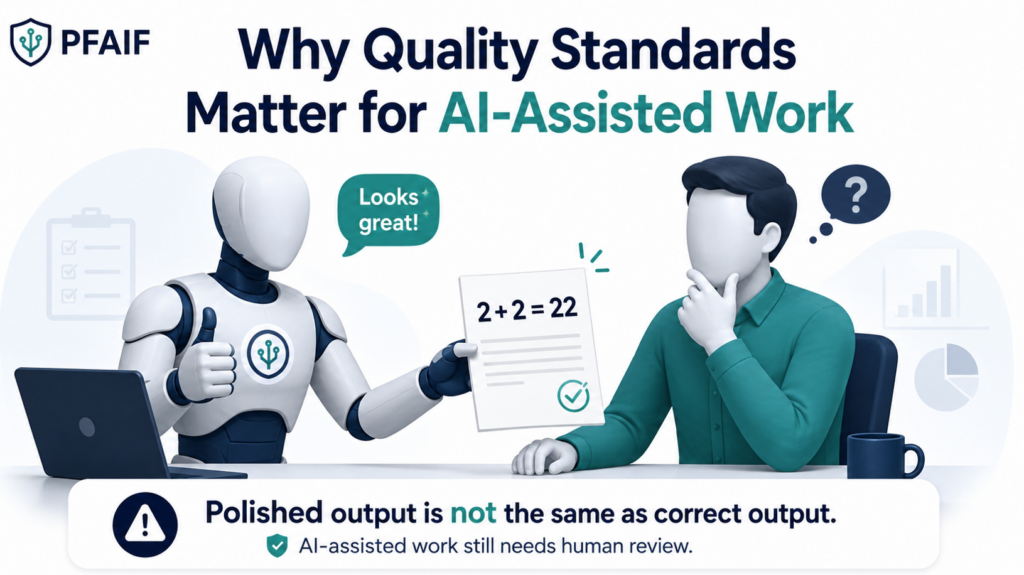
AI output often looks finished before it is actually trustworthy.
That is why quality standards matter.
The goal is not to slow everyone down with unnecessary review. The goal is to prevent AI from creating hidden errors, rework, customer problems, compliance issues, or employee frustration.
Why AI-Assisted Work Needs Quality Standards
Most companies already have quality standards, even if they are informal. A service technician knows what a complete job note should include. A marketing writer knows what a good article needs. A lawyer knows what must be checked before legal work is used. A customer service representative knows when a message sounds right and when it sounds off.
AI changes this because it can create output very quickly and very confidently.
That speed can be useful, but it can also create problems. Employees may assume the output is good because it sounds good. Managers may assume AI is saving time because the first draft appears quickly. Leaders may think the process is improving because more content, summaries, responses, or reports are being produced.
But speed is not the same as quality.
A company can produce more work and still create worse outcomes if that work is inaccurate, generic, incomplete, off-brand, unsafe, or difficult for the next person in the workflow to use.
Quality standards help employees answer a practical question: What has to be true before this AI-assisted output is good enough to use?
Without that answer, AI adoption becomes risky.
The AI Cleanup Problem
One of the biggest hidden costs of AI adoption is cleanup work.
AI may save time for the person who generates the output, but if another person has to fix it later, the business may not actually save time. The work just moves downstream.
For example, a technician might use AI to turn a few rough notes into a polished service summary. That sounds helpful. But if the AI summary leaves out the actual diagnosis, adds details that did not happen, or uses vague language, the office team may have to call the technician for clarification. The summary looked better, but it did not make the workflow better.
A marketing writer might use AI to create a blog draft. The draft may be long, organized, and readable. But if it is generic, missing local details, making unsupported claims, or repeating the same phrasing as every other AI-generated article, the editor may spend more time fixing it than they would have spent improving a human outline.
A customer service representative might use AI to draft a response to a frustrated customer. The message may sound polite, but it may fail to address the actual complaint. Worse, it might accidentally promise something the company cannot honor.
That is the AI cleanup problem.
AI creates output fast, but people still have to make it right.
Quality standards reduce cleanup work by making review expectations clear before the output moves forward.
What Counts as Good AI-Assisted Work?
Good AI-assisted work is not just work that sounds polished. It should meet the same standards the organization would expect from human-created work, plus a few extra checks because AI can invent, omit, distort, or overstate information.
In most business settings, good AI-assisted work should be accurate, complete, relevant, clear, appropriate for the audience, aligned with company policy, reviewed by a responsible person, and useful in the workflow.
That means a customer message should not only sound friendly. It should reflect the actual customer situation. It should use approved pricing, warranty, and service language. It should avoid promises the company cannot keep. It should be reviewed before sending.
A meeting summary should not only be well formatted. It should capture the actual decisions, action items, owners, and deadlines. It should not invent commitments. It should be reviewed by someone who attended the meeting or owns the follow-up.
A marketing outline should not only include keywords. It should match search intent, reflect the client’s actual services, avoid unsupported claims, and give the writer a useful structure.
A legal summary should not only be readable. It should be verified by a qualified professional before anyone relies on it.
Quality standards turn “this looks good” into “this is good enough to use for this purpose.”
That distinction matters.
Start by Defining the Risk Level of the AI Task
Not every AI-assisted task needs the same level of review.
A low-risk internal brainstorming prompt does not need the same quality standard as a customer-facing message, legal summary, medical communication, financial analysis, safety instruction, or public marketing claim.
Leaders should start by grouping AI tasks by risk.
Low-risk tasks may include internal brainstorming, first-pass outlines, meeting agenda ideas, rough categorization, or rewriting informal internal notes for clarity. These still need judgment, but the risk is usually lower because the output is not directly affecting customers, compliance, money, safety, or legal obligations.
Medium-risk tasks may include customer follow-up drafts, internal reports, sales summaries, service notes, review responses, job descriptions, training materials, and client-facing drafts. These usually need clear review before use.
High-risk tasks may include legal, medical, financial, HR, safety, regulatory, disciplinary, contractual, or sensitive customer communication. These should have stricter review rules, approved tools, defined accountability, and often professional oversight.
For example, a restaurant manager using AI to brainstorm social media captions is a lower-risk use case. That same manager using AI to respond to a food safety complaint is a higher-risk use case.
A dental office using AI to draft a generic appointment reminder from an approved template may be relatively low risk. Using AI to provide personalized clinical advice would be high risk and generally inappropriate without proper professional review.
Quality standards should match the risk of the task.
Define Who Owns the Final Work
One of the most important quality standards is ownership.
AI should not be treated as the owner of the output. A person or team must be responsible for reviewing and approving AI-assisted work before it is used.
This sounds obvious, but it is easy for accountability to become blurry.
An employee may say, “The AI wrote it.” A manager may say, “The employee should have checked it.” Leadership may say, “The tool was supposed to help.” Meanwhile, the customer receives inaccurate information, the client gets a weak deliverable, or the team has to fix a problem nobody owned.
Every AI use case should answer this question:
Who is responsible for the final output?
For an HVAC company, a CSR may own the final customer follow-up message, even if AI drafted it. The CSR is responsible for checking accuracy, tone, job details, and any pricing or warranty language before sending.
For a marketing agency, the writer and editor may own the final article, even if AI helped with the outline or first draft.
For a law firm, the attorney owns the final legal interpretation, even if AI helped summarize documents.
For an accounting firm, the accountant or reviewer owns the final client-facing explanation, even if AI helped draft a plain-language version.
Ownership protects the business and the employee. It makes expectations clear. It also reinforces that AI is a tool, not an accountable worker.
Create a Review Checklist for Each Use Case
Quality standards become much easier to apply when employees have a simple checklist.
A checklist does not need to be complicated. It should match the use case and help employees catch the most likely problems.
For example, a customer follow-up message checklist might include:
- Is the customer’s issue described accurately?
- Does the message match the actual service performed?
- Are pricing, warranty, and recommendation details correct?
- Is the tone appropriate for the customer situation?
- Does the message avoid promises we cannot keep?
- Has a person reviewed the message before sending?
A technician job note checklist might include:
- Does the note include the problem reported by the customer?
- Does it include the diagnosis?
- Does it include work performed?
- Does it include parts used or recommended?
- Does it avoid adding details that were not documented?
- Can the office team understand the note without calling back for clarification?
A marketing content checklist might include:
- Is the information accurate?
- Does the content match the client’s services and service area?
- Are claims supported?
- Does the content avoid generic filler?
- Does it match the brand voice?
- Has the editor reviewed the final version?
A meeting summary checklist might include:
- Are action items accurate?
- Are owners and deadlines correct?
- Are decisions clearly separated from discussion points?
- Are uncertain items marked for follow-up?
- Did someone who attended the meeting review the summary?
Checklists make quality standards practical.
They also reduce the chance that each employee creates their own private version of “good enough.”
Example: Quality Standards in a Home Services Company
A home services company may use AI to help with technician notes, customer messages, review responses, and maintenance plan follow-ups.
Without quality standards, the company may run into problems quickly. AI may create customer messages that sound professional but miss important job details. It may summarize technician notes in a way that looks clean but hides uncertainty. It may create review responses that sound too generic. It may accidentally overpromise on warranties, timelines, discounts, or repair outcomes.
A practical quality standard for AI-assisted customer follow-up might say:
AI may create first-pass drafts, but a CSR must review every message before sending. The CSR must verify the service performed, pricing, warranty language, recommended next steps, tone, and any customer-specific concern. AI may not invent technical details, change company policy, offer discounts, or respond to complaints without human review.
That standard gives employees useful boundaries.
It also protects the customer experience. The customer does not care whether AI helped draft the message. They care whether the message is accurate, helpful, and trustworthy.
Example: Quality Standards in a Dental Office
A dental office may use AI for appointment preparation messages, routine reminders, internal checklists, and front desk communication. These tasks can be useful, but the office needs strict boundaries because patient communication can become sensitive quickly.
A quality standard might say:
AI may be used to draft routine appointment reminders or preparation instructions based on approved office templates. Staff must review every message before sending. AI should not be used to provide diagnosis, treatment advice, personalized clinical recommendations, or responses involving sensitive patient information unless approved through the proper clinical and compliance process.
This standard helps the front desk team use AI without crossing into areas that should remain clinical or protected.
It also helps employees feel safer. They do not have to guess whether a task is appropriate for AI. The boundary is clear.
For a dental office, the quality standard should not only ask, “Is this message well written?” It should ask, “Is this message appropriate for AI assistance in the first place?”
That is a more responsible standard.
Example: Quality Standards in a Marketing Agency
A marketing agency may be tempted to use AI heavily because content production is time-consuming. AI can help with outlines, summaries, research organization, title ideas, meta descriptions, draft sections, and editing support.
But agency work depends on quality. If AI creates generic content, unsupported claims, repetitive phrasing, or inaccurate recommendations, the agency can damage client trust.
A useful quality standard might say:
AI may be used for first-pass outlines, research organization, content structure ideas, and editing support. AI-generated content should not be published without human review. Writers and editors must verify factual claims, local relevance, client-specific details, service accuracy, originality, brand voice, and search intent before final delivery.
For example, if AI drafts a blog about HVAC maintenance, the editor should check whether the recommendations are accurate for the client’s region, services, equipment types, and customer needs. If the blog includes statistics, those should be verified. If it mentions a coupon, financing offer, warranty, or service promise, that information should be confirmed.
AI can make content faster, but it can also make bad content faster.
Quality standards prevent volume from replacing value.
Example: Quality Standards in a Law Firm
A law firm should treat AI-assisted work with especially careful review.
AI may be useful for internal summaries, issue organization, administrative drafting, document classification, or first-pass research support. But legal judgment, confidentiality, accuracy, and accountability cannot be handed over to an AI tool casually.
A law firm quality standard might say:
AI may assist with internal document summaries only when approved tools and approved data practices are used. AI-generated summaries must be reviewed by an attorney before being relied on. AI output should not be used directly in legal advice, court filings, contracts, client recommendations, or legal conclusions without attorney verification.
The point is not that AI can never support legal work. The point is that the quality standard must match the risk.
A polished legal-sounding AI answer can be dangerous if it is wrong. The firm needs a standard that makes review, verification, and accountability non-negotiable.
Example: Quality Standards in an Accounting Firm
An accounting firm might use AI for client communication, document request explanations, meeting summaries, internal checklists, or first-pass plain-language explanations.
The quality standard should separate communication support from professional judgment.
For example:
AI may be used to draft plain-language explanations of routine document requests or administrative follow-up messages. A staff member must review the message before sending. AI should not create final tax advice, interpret complex client situations, or make filing recommendations without professional review.
During tax season, this can be helpful. Staff may spend hours answering repeat questions about missing forms, receipts, expense categories, or deadlines. AI can help draft clearer explanations, but the firm still needs to verify that the message is accurate and appropriate for the client’s situation.
The standard should protect both efficiency and professional responsibility.
Quality Standards Should Include “Do Not Use AI” Rules
A strong quality standard does not only say how to review AI output. It also says when AI should not be used.
This is important because employees may assume that if AI is allowed in one task, it is allowed in related tasks. That is not always true.
For example, a restaurant group may allow AI to draft routine positive review responses, but not complaints involving food safety, injuries, discrimination, employee behavior, legal threats, or refund disputes.
A home services company may allow AI to draft routine maintenance reminder messages, but not safety instructions, complex diagnostic explanations, or disputed billing responses without manager review.
A marketing agency may allow AI to generate outline ideas, but not invent client testimonials, statistics, case studies, or performance claims.
A dental office may allow AI to draft appointment reminders, but not treatment recommendations.
A law firm may allow AI to summarize internal documents, but not create final legal conclusions.
Employees need these boundaries in plain language.
Clear “do not use AI” rules reduce risk and make responsible experimentation easier.
Monitor Whether AI Creates Extra Correction Work
A quality standard should not end at review. Leaders should also monitor whether AI is creating extra correction work.
This is a major part of people-first AI implementation. AI should improve work across the workflow, not simply make one step appear faster.
For example, if technicians use AI to create cleaner job notes, but the office team still has to call them for missing details, the process may not be improving. If writers use AI to draft content, but editors spend more time fixing generic sections, the workflow may not be better. If customer service uses AI to draft replies, but managers have to review and rewrite every message, the time savings may not be real.
Leaders should ask employees:
- Does AI save time after review is included?
- Does AI output reduce errors or create new ones?
- Does it make work clearer for the next person in the process?
- Does it improve consistency?
- Does it create more cleanup work?
- Does the team trust the output enough to keep using it?
These questions matter because AI success should be evaluated based on usefulness, not just output volume.
PFAIF treats this directly as part of quality readiness because one of the quality standard items asks whether the organization monitors whether AI creates extra correction work for employees.
Set Different Standards for Drafts, Internal Use, and External Use
Not all AI-assisted work needs to be treated the same way. Leaders should make a clear distinction between draft work, internal work, and external work.
Draft work is early-stage support. This may include brainstorming, rough outlines, internal notes, or first-pass summaries. The quality standard can be lighter, but employees should still understand that the output is not final.
Internal work may include reports, summaries, checklists, meeting notes, training materials, or operational documents. These outputs may not go to customers, but they can still affect decisions and workflows. They should be reviewed for accuracy and completeness.
External work includes customer emails, client deliverables, public content, proposals, legal documents, patient messages, financial explanations, review responses, or anything that represents the company publicly. These require stronger review.
For example, a marketing team may use AI to brainstorm blog title ideas with minimal risk. But if AI drafts a client-facing SEO recommendation, that should be reviewed carefully before delivery.
A manager may use AI to organize thoughts before a team meeting. But if AI drafts a policy update, that needs a much higher standard.
This three-level distinction helps employees understand how careful they need to be depending on where the output will go.
Create Examples of Good and Bad AI-Assisted Work
One of the best ways to teach quality standards is to show examples.
Employees often understand quality better when they can compare a weak output to a strong one.
For example, a home services company could show a weak AI-generated customer follow-up that is vague, misses the specific repair, and makes an unsupported promise. Then it could show a strong version that uses the actual job details, avoids overpromising, and clearly explains the next step.
A marketing agency could show an AI-generated paragraph that sounds polished but says nothing specific. Then it could show a stronger version that includes the client’s service area, actual service offering, audience need, and verified information.
A dental office could show a reminder message that is too clinical or too vague. Then it could show a clearer version based on approved office language.
A law firm could show a summary that misses uncertainty or overstates a conclusion. Then it could show a safer internal summary that clearly labels what needs attorney review.
Examples make quality standards concrete.
They also help employees see that AI output should be evaluated, not admired just because it sounds fluent.
Do Not Let AI Lower the Standard
A common mistake is accepting lower-quality work because “AI helped with it.”
That is backwards.
AI-assisted work should still meet the organization’s normal quality expectations. In some cases, the standard should be higher because AI can introduce hidden risks.
- If a company would not send a vague customer message written by an employee, it should not send a vague customer message written by AI.
- If a company would not publish an unsupported claim written by a human, it should not publish one generated by AI.
- If a manager would not accept incomplete notes from a team member, they should not accept incomplete notes because AI formatted them nicely.
AI does not excuse weak work.
It should support better work.
Leaders should make this clear early. Otherwise, employees may think AI speed matters more than quality, and managers may reward volume without noticing downstream problems.
How to Build AI Quality Standards Step by Step
A practical way to build AI quality standards is to start with one use case.
- First, define the AI task. What will AI help create, summarize, classify, draft, or organize?
- Second, identify the risks. What could go wrong if the output is inaccurate, incomplete, generic, biased, inappropriate, or used without review?
- Third, define the owner. Who is responsible for final approval?
- Fourth, create a review checklist. What must be checked before the output is used?
- Fifth, define boundaries. What should AI not do in this use case?
- Sixth, decide where the output can go. Is it for brainstorming, internal use, or external use?
- Seventh, monitor correction work. Is the AI output reducing work or creating more rework?
- Eighth, revise the standard after real use. Employees will find issues that leadership did not predict.
This process does not need to be complicated. It needs to be specific enough that employees know what good looks like.
A Simple AI Quality Standard Template
Leaders can use this template for each AI use case.
AI Use Case:
What task will AI support?
Output Type:
What will AI produce?
Primary User:
Who will use the AI?
Final Owner:
Who is responsible for approving the final work?
Review Requirements:
What must be checked before use?
Accuracy Standard:
What facts, details, policies, or claims must be verified?
Tone and Audience Standard:
What tone is appropriate for the audience?
Boundary Rules:
What should AI not do?
Data Rules:
What information should not be entered into the tool?
Escalation Rules:
When should the employee stop and ask a manager or specialist?
Correction Tracking:
How will we track whether AI creates rework?
Success Criteria:
How will we know whether AI improved quality, speed, consistency, or trust?
This kind of template turns AI quality from a vague concern into a manageable process.
How Quality Standards Fit Into PFAIF
In PFAIF, quality standards sit between role-specific training and pilot testing. That order matters.
Employees first need to understand the workflow, the use case, the change, and how AI applies to their role. Then they need quality standards that define what good AI-assisted work looks like. After that, the organization can pilot the use case in a safer and more structured way.
Quality standards also connect directly to trust. Employees are more likely to trust AI when they know how to check it. Managers are more likely to trust AI-assisted workflows when they know review responsibilities are clear. Customers are more likely to trust the business when AI-assisted communication remains accurate, helpful, and human-reviewed where needed.
The PFAIF assessment defines quality standards through practical readiness questions, including whether the organization has clear standards, whether employees know who reviews AI-assisted outputs, whether important work is checked, whether employees verify AI outputs rather than accept them automatically, and whether the organization monitors extra correction work.
That is the heart of this topic. Quality standards are not about making AI harder to use. They are about making AI safer, clearer, and more useful.
Practical Checklist: Quality Standards for AI-Assisted Work
Before using AI-assisted work in a real workflow, leaders should be able to answer these questions:
- What kind of output will AI create?
- Who will use that output?
- Who owns the final version?
- Is the output for brainstorming, internal use, or external use?
- What facts or details must be verified?
- What tone or style is required?
- What policies, legal rules, safety issues, or customer promises must be checked?
- What should AI never be allowed to decide or generate in this workflow?
- What information should employees avoid entering into the tool?
- What does a good AI-assisted output look like?
- What does a bad AI-assisted output look like?
- How will employees report errors?
- How will leaders track whether AI creates correction work?
- How will the quality standard be updated after real use?
If these questions are not clear, the AI use case is probably not ready to scale.
Common Mistakes With AI Quality Standards
The first mistake is assuming employees will know how to review AI output without guidance. Many employees can tell when something feels wrong, but they still need clear standards for what must be checked.
The second mistake is treating all AI output the same. A brainstormed internal idea does not need the same review as a customer-facing message or legal summary.
The third mistake is letting AI output move downstream too quickly. Fast output can create slow cleanup if it reaches the next person before review.
The fourth mistake is failing to define ownership. Someone must be responsible for the final work.
The fifth mistake is focusing only on accuracy. Accuracy matters, but quality also includes completeness, tone, relevance, policy fit, customer impact, brand fit, and usefulness.
The sixth mistake is not tracking rework. If AI creates more correction work than value, leaders need to know that.
The seventh mistake is allowing AI to lower the standard. If the organization would not accept the work from a person, it should not accept it from AI.
AI-assisted work needs quality standards because AI can make imperfect work look complete. That does not mean companies should avoid AI. It means they should use it with clear expectations. Employees need to know what good AI-assisted work looks like, what must be checked, who owns the final output, when AI should not be used, and how to report problems. Leaders need to measure whether AI is improving the workflow or just creating faster drafts that someone else has to fix.
The goal is not to create bureaucracy. The goal is to make AI useful without letting quality slip.
Take the PFAIF Readiness Assessment
The PFAIF Readiness Assessment helps organizations evaluate people-first AI readiness across workflow assessment, use case definition, change communication, role-specific training, quality standards, pilot testing, adoption and trust measurement, and feedback loops.
Use it to identify where your organization is strongest and where more support may be needed before scaling AI.
Take the PFAIF Readiness Assessment
Learn more about the People-First AI Implementation Framework
Watch the recorded PFAIF webinar
FAQ
What are quality standards for AI-assisted work?
Quality standards for AI-assisted work are the rules and review expectations used to decide whether AI output is accurate, complete, appropriate, useful, and safe to use. They define what must be checked, who owns the final output, and when AI should not be used.
Why does AI-assisted work need quality standards?
AI-assisted work needs quality standards because AI can create output that sounds polished but is still wrong, incomplete, generic, or inappropriate. Without standards, employees may use AI output too quickly or create extra correction work for others.
Who should review AI-assisted output?
A person or team should always own final review of AI-assisted output. The reviewer depends on the use case. A CSR may review customer messages, an editor may review marketing content, an attorney may review legal summaries, and a manager may review internal reports.
What should employees check in AI output?
Employees should check AI output for accuracy, missing details, unsupported claims, tone, relevance, policy fit, customer impact, sensitive information, and whether the output matches the actual workflow or situation.
When should AI not be used?
AI should not be used when the task requires human judgment, professional expertise, confidential information, sensitive customer issues, legal or clinical advice, safety decisions, final financial recommendations, or any use case the organization has not approved.
How do quality standards fit into PFAIF?
In the People-First AI Implementation Framework, Quality Standards is one of the eight readiness areas. It focuses on whether organizations define review expectations, assign responsibility for AI-assisted output, verify important work, and monitor whether AI creates extra correction work.