Leaders should communicate AI adoption to employees by clearly explaining why AI is being introduced, what problem it is meant to solve, how it will affect day-to-day work, what employees are expected to do, what remains human-led, how AI outputs should be reviewed, and how employees can raise concerns or provide feedback. In the People-First AI Implementation Framework, or PFAIF™, change communication is one of the core readiness areas because employees are more likely to trust and use AI when leadership is clear, honest, and realistic about what is changing.
This matters because AI communication is often where leaders accidentally create resistance.
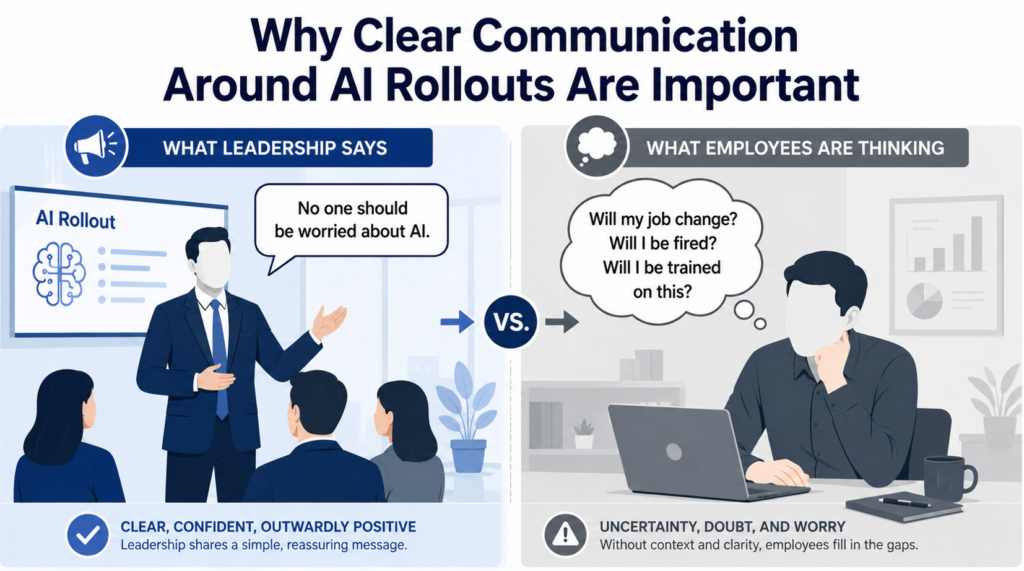
A company may have a decent AI tool, a reasonable use case, and good intentions. But if the message to employees is vague, overly optimistic, or full of corporate buzzwords, people may fill in the blanks themselves. They may wonder if AI is really about helping them or replacing them. They may worry that leadership is using “productivity” as a softer word for headcount reduction. They may wonder whether their performance will be judged against AI output they do not fully control.
Those concerns are not irrational. They are human.
If leaders want AI adoption to work, they need to treat communication as part of the implementation plan, not as an announcement at the end.
Why AI Communication Is More Important Than You Think
AI is different from many other workplace tools because it touches people’s sense of value, security, competence, and control. A new scheduling system may be annoying. A new CRM may require training. But AI can feel more personal because it can write, summarize, analyze, recommend, generate, and automate parts of work that employees may see as tied to their expertise.
That does not mean employees will automatically reject AI. Many employees are curious about it. Some are already using it. Many would welcome tools that reduce repetitive work, help them organize information, or make annoying tasks easier.
The problem is not always AI itself. The problem is how AI is introduced.
When leaders communicate poorly, employees may hear one message while leadership thinks it is sending another. Leadership may say, “We are using AI to increase efficiency.” Employees may hear, “We are going to expect more work with fewer people.” Leadership may say, “AI will help everyone be more productive.” Employees may hear, “If you do not use this perfectly, you will fall behind.” Leadership may say, “We want everyone to experiment.” Employees may hear, “There are no rules, but we will still judge the results.”
Clear communication reduces those gaps.
It gives employees context, boundaries, expectations, and a way to participate in the change.
The Wrong Way to Announce AI Adoption
A weak AI announcement usually sounds something like this:
“We are excited to announce that we are embracing AI across the company to improve productivity, increase efficiency, and stay ahead of the competition. We expect everyone to start experimenting with AI tools and finding ways to use them in their daily work.”
That may sound positive from a leadership perspective, but it leaves too much unanswered.
Employees may immediately wonder what “embracing AI” means. Are they required to use it? Which tool should they use? What tasks are approved? Can they enter customer information? Who checks the output? What if the AI is wrong? Will using AI be part of performance reviews? Will this reduce jobs? Who do they ask if they are uncomfortable?
A vague announcement can create more anxiety than clarity.
It also pushes responsibility onto employees without giving them enough structure. Telling people to “find ways to use AI” may seem empowering, but it can easily become chaotic. Some employees may use AI in helpful ways. Others may use it in risky ways. Others may avoid it because they do not want to make a mistake.
Good communication does not just tell employees that AI is coming.
It explains what is changing and how the organization will support the change.
A Better Way to Communicate AI Adoption
A stronger AI adoption message is specific, honest, and grounded in the actual work.
For example, a small business might say:
“We are testing AI to help draft first-pass customer follow-up messages after completed service visits. The goal is to reduce repetitive writing and help the office team respond more consistently. AI will not send messages automatically. A customer service representative will review every message before it goes to a customer. During the pilot, we want feedback on whether the drafts are useful, accurate, and worth continuing.”
That message is much better because it explains the use case, the purpose, the review process, and the feedback loop.
It also avoids pretending that AI is perfect. It tells employees that the company is testing, not forcing. It makes clear that human review still matters. It invites feedback instead of demanding blind adoption.
A good AI communication message should answer the questions employees are already asking in their heads.
What is being introduced? Why are we doing this? Who will use it? What work will it affect? What should employees do differently? What should AI not do? Who owns the final output? How will we measure whether this helps? How can employees raise concerns?
When those questions are answered early, AI adoption feels less like a mystery and more like a managed change.
Start With the Problem, Not the Tool
One of the best ways to communicate AI adoption is to start with the business problem, not the technology.
Employees do not need to hear a long speech about how powerful AI is. They need to understand what problem the organization is trying to solve.
For example, an HVAC company might say:
“Our customer service team spends a lot of time turning technician notes into customer follow-up messages. Sometimes the notes are clear. Sometimes they are incomplete. Sometimes the office team has to go back to the technician for more detail. We are testing AI to help create first-pass drafts from completed job notes so the CSR team can respond faster, while still reviewing every message before it is sent.”
That explanation starts with the actual workflow problem. It does not frame AI as a shiny new tool. It frames AI as a possible support for a known issue.
A dental office might say:
“Our front desk team spends a lot of time repeating the same appointment preparation instructions. We are testing AI to help draft plain-language reminders based on approved templates. Staff will review the messages before they are sent, and AI will not be used for diagnosis or treatment advice.”
Again, the message starts with the work.
This matters because employees are more likely to accept AI when they can see how it connects to a real pain point. If AI is introduced as a vague company initiative, it may feel like another top-down mandate. If it is introduced as support for a workflow employees already know is frustrating, it becomes more practical.
Be Honest About Job Security Concerns
Leaders do not build trust by pretending employees are not worried about job security.
People know AI can automate tasks. They know companies care about efficiency. They know some organizations will use AI to reduce labor costs. If leadership avoids the topic completely, employees may assume the worst.
That does not mean every AI announcement needs to include a dramatic speech about layoffs. But leaders should acknowledge the concern directly and honestly.
A weak message would be:
“No one should be worried about AI.”
That sounds dismissive. It tells employees how to feel instead of addressing why they feel that way.
A better message would be:
“We understand that AI raises real questions about how work will change. For this rollout, the goal is to reduce repetitive tasks and improve consistency in this specific workflow. We are not using this pilot to replace roles. We are using it to learn where AI can support the team, where it creates problems, and what guardrails we need before expanding.”
That message is more credible because it acknowledges the concern and narrows the claim. It does not make promises about all future uses of AI. It explains the current purpose and invites evaluation.
Leaders should avoid making broad promises they cannot guarantee. Saying “AI will never affect jobs here” may not be realistic. Saying “This pilot is not designed to replace roles, and we will communicate clearly if the purpose changes” is more honest.
Trust is built through specific, realistic communication.
Explain What Remains Human-Led
Employees need to know where human judgment still matters.
One of the biggest fears around AI is that leadership will start treating AI output as automatically correct. That fear is reasonable. AI can sound confident even when it is wrong, incomplete, generic, or missing context.
A strong communication plan should explain what AI can support and what remains human-led.
For example, a marketing agency might tell its team:
“We are using AI to help with first-pass outlines and research organization. Final strategy, client recommendations, editing, originality, and quality control remain human responsibilities.”
That is clear. Writers and editors know AI is not replacing their judgment. It is being used in a defined part of the workflow.
A law firm might say:
“We are testing AI for internal document summaries only. Attorneys remain responsible for reviewing the summaries, verifying accuracy, and making all legal judgments. AI output should not be copied into client-facing work without attorney review.”
A restaurant group might say:
“We are using AI to draft responses to routine positive reviews. Managers must review every response before posting. Complaints involving food safety, employee behavior, injuries, discrimination, refunds, or legal concerns should not be handled by AI.”
These boundaries matter.
Employees are more likely to trust AI when they know where the human role begins and ends.
Communicate What AI Should Not Be Used For
Good AI communication should include limits.
Many leaders focus only on what AI can do. Employees also need to know what AI should not do.
For example, a company may tell employees not to enter sensitive customer data, confidential business information, employee records, protected health information, legal strategy, financial account details, or proprietary client information into unapproved AI tools.
But the boundaries should go beyond data privacy. Employees also need task boundaries.
A dental office might say AI should not provide diagnosis or treatment recommendations. A law firm might say AI should not make legal conclusions. An accounting firm might say AI should not provide final tax advice. A home services company might say AI should not change pricing, warranty language, or safety recommendations without human review. A marketing agency might say AI should not invent facts, statistics, testimonials, or client claims.
This is not about scaring employees away from AI. It is about helping them use AI responsibly.
When employees know the boundaries, they can experiment with more confidence.
Make Communication Role-Specific
A company-wide AI announcement is not enough.
Different teams need different messages because AI affects their work in different ways. The customer service team may need to understand how AI will help with call summaries or follow-up emails. The sales team may need to know how AI can support meeting prep or CRM notes. The operations team may need to know how AI fits reporting, scheduling, or routing. Managers may need to know how to review AI-assisted work and coach employees.
A generic message may be useful as a starting point, but it should be followed by role-specific communication.
For example, in a home services company, technicians do not need the same message as office staff. Technicians may need to know how AI will affect job notes, service summaries, and required documentation. CSRs may need to know how AI will affect customer follow-ups and complaint responses. Managers may need to know how to evaluate whether AI is reducing rework or just moving work from one team to another.
A marketing agency may need separate messages for writers, editors, SEO strategists, account managers, and leadership. Writers may need clarity on whether AI can be used for outlines or drafts. Editors may need review standards. Account managers may need to know what can be shared with clients. Leadership may need to define quality expectations.
Role-specific communication makes AI adoption feel relevant instead of abstract.
It also reduces the chance that employees will misunderstand what is expected of them.
Avoid Overhyping AI
Overhyping AI is one of the fastest ways to damage trust.
Employees can usually tell when leadership is overselling a tool. If the message sounds like AI will magically save time, eliminate busywork, improve quality, and transform the company overnight, people may become skeptical before the rollout even starts.
Worse, overhype can create unrealistic expectations. If employees are told that AI will save hours each week, but the tool produces output they have to clean up, frustration will build quickly.
A better approach is to communicate AI as a tool with potential and limits.
For example:
“We believe this tool may help reduce repetitive drafting work, but we expect there will be issues during the pilot. We want to understand where it helps, where it fails, and what needs to change before we expand it.”
That is a much stronger message than:
“This tool is going to revolutionize the way we work.”
Realistic communication builds credibility. It gives employees permission to point out problems without feeling like they are being negative. It also helps leadership learn faster because employees are more likely to share honest feedback.
AI adoption does not need hype.
It needs trust.
Explain How Success Will Be Measured
Employees should know how leadership will judge whether AI is working.
If success is unclear, employees may assume leadership only cares about usage or speed. That can create bad incentives. People may use AI just to show they are using it. They may prioritize faster output even when quality drops. They may avoid reporting problems because they think leadership already decided the tool is a success.
Good AI communication should define success in practical terms.
For example, a customer service team might measure whether AI-assisted follow-ups are accurate, reviewed quickly, sent faster, and trusted by the employees using them. A marketing team might measure whether AI-assisted outlines reduce planning time without lowering content quality. A law firm might measure whether document summaries help attorneys review materials faster without missing important details. An operations team might measure whether AI-generated reports reduce manual work without increasing corrections.
The key is to measure usefulness, not just access.
Leaders should also explain that feedback matters. If the tool creates more cleanup work than value, that should count as an important finding, not employee failure.
This aligns directly with PFAIF because the framework treats AI success as a readiness and adoption issue, not just a technology access issue. The PFAIF assessment includes outcome concepts such as perceived adoption success, productivity improvement, work quality, employee trust, willingness to use AI, correction burden, and leadership-employee alignment.
Create a Feedback Channel Before Problems Pile Up
Employees need a clear way to report what is working and what is not.
If there is no feedback channel, problems may stay hidden. Employees may quietly fix AI mistakes, avoid the tool, complain privately, or create their own workarounds. By the time leadership realizes adoption is weak, trust may already be damaged.
A feedback channel does not have to be complicated. It can be a short form, a weekly pilot meeting, a shared document, manager check-ins, or a dedicated Slack or Teams channel. What matters is that employees know where to send feedback and believe someone will act on it.
For example, during an AI pilot in a plumbing company, CSRs could be asked to record when AI-generated follow-up messages are helpful, when they require heavy editing, and what types of jobs produce bad drafts. That feedback could be reviewed weekly and used to improve the prompt, adjust the workflow, or decide whether the use case is worth continuing.
In a restaurant group, managers testing AI review responses could flag responses that sound too generic, too defensive, or inappropriate for sensitive complaints. That feedback could become part of the review standard.
In a marketing agency, editors could track where AI outlines save time and where they create repetitive or shallow recommendations. That feedback could help decide which content types are a good fit.
The message to employees should be simple: “We do not expect this to be perfect. We need your feedback to make it better.”
That kind of communication builds participation.
Communicate Before, During, and After the Rollout
AI communication should not happen once.
A single announcement is not enough for a meaningful workplace change. Leaders should communicate before the rollout, during the pilot, and after implementation.
Before the rollout, explain the reason for the change, the use case, the expected impact, the boundaries, and the support plan. This is where leaders should address employee concerns directly and set realistic expectations.
During the pilot, communicate what is being learned. Share early findings, common questions, mistakes to avoid, and changes being made based on feedback. Employees should see that the organization is listening.
After launch, continue communicating updates. Explain what changed, what feedback was used, what standards are being updated, and what the next phase looks like.
This is especially important because AI tools and workflows will change over time. What works in the first month may need adjustment later. New risks may appear. Employees may discover better ways to use the tool. Managers may realize the original success metrics were incomplete.
Ongoing communication keeps the rollout from becoming a forgotten announcement.
It also reinforces that AI adoption is a process, not a one-time event.
Example: AI Communication in a Home Services Company
A home services company wants to test AI for technician job notes and customer follow-ups.
A poor communication approach would be:
“We are rolling out AI to make job documentation more efficient. Everyone should start using the tool this month.”
That message is too vague. It does not explain what is changing, how employees should use AI, what must be reviewed, or what the company will measure.
A stronger message would be:
“We are testing AI with a small group of technicians and CSRs to improve service documentation and customer follow-up messages. The goal is to reduce missing information and help the office team respond more consistently after completed jobs. Technicians will still be responsible for accurate job details. CSRs will review every customer message before it is sent. During the pilot, we will track whether this reduces follow-up delays, improves note quality, and creates less rework for the office team.”
That message is practical. It explains the workflow, the purpose, the human responsibilities, and the success criteria.
It also makes clear that AI is not being forced blindly across the whole company.
That is the kind of communication that makes adoption more realistic.
Example: AI Communication in a Marketing Agency
A marketing agency wants to introduce AI into the content workflow.
A poor message would be:
“We are now using AI to speed up content production. Writers should start using AI to help create blogs and website copy.”
That message could easily create fear and quality problems. Writers may worry that leadership is trying to replace them. Editors may worry they will be buried in low-quality AI drafts. Clients may wonder whether they are paying for original strategy or generic AI output.
A better message would be:
“We are testing AI in the content planning process. For now, AI may be used to organize research notes, generate first-pass outlines, and identify possible section ideas. Writers remain responsible for original drafting, client-specific insight, accuracy, and voice. Editors will review AI-assisted outlines before they move into drafting. We are not using AI to publish final content without human review.”
That message gives the team boundaries. It also positions AI as planning support rather than a replacement for strategy and writing judgment.
The agency could also tell the team what it wants to learn during the pilot: Does AI reduce planning time? Are outlines useful? Does it create generic ideas? Does it help newer writers? Does it create extra editorial work?
That kind of communication makes the rollout feel controlled and professional.
Example: AI Communication in a Dental Office
A dental office wants to use AI to help with patient communication.
A weak message would be:
“We are using AI to help with patient messages and front desk work.”
That could make staff nervous and create privacy concerns.
A stronger message would be:
“We are testing AI to help draft appointment preparation messages and routine reminder language based on approved office templates. Staff will review every message before it is sent. AI should not be used for diagnosis, treatment recommendations, clinical judgment, or entering sensitive patient information into unapproved tools. The goal is to reduce repetitive writing and make patient instructions clearer.”
This message is clear and safe. It tells staff exactly where AI fits and where it does not.
It also reassures employees that AI is not taking over clinical communication. It is supporting a narrow administrative workflow.
For businesses in sensitive industries, this kind of boundary-setting is not optional. It is part of responsible implementation.
What Leaders Should Say About AI Mistakes
AI will make mistakes. Employees already know this. Leaders should say it clearly.
A good message might be:
“AI output should be treated as a draft or recommendation, not as automatically correct. Employees are expected to review the output before using it. If the AI creates inaccurate, incomplete, biased, unsafe, or low-quality output, report it through the pilot feedback process so we can improve or stop the use case.”
This message does three useful things.
It prevents overreliance. It makes human review part of the process. It also tells employees that reporting problems is expected, not punished.
Leaders should avoid creating a culture where employees feel pressure to pretend AI is working better than it is. That kind of culture hides risk.
A healthy AI rollout makes it normal to say, “This output is not good enough.”
That is not resistance. That is quality control.
What Leaders Should Not Say About AI Adoption
There are a few phrases leaders should be careful with.
“AI will not affect anyone’s job.” This may sound reassuring, but it can come across as unrealistic unless leadership can truly support it. It is usually better to be specific about the current use case and honest about the fact that work may change.
“Everyone needs to become an AI expert.” Most employees do not need to become AI experts. They need to know how to use approved tools responsibly in their roles.
“AI will save everyone time.” Maybe it will, but not always. It may save time in one step while creating review work in another. It is better to say the organization is testing whether AI saves time after review and correction are included.
“Just experiment.” Experimentation can be useful, but employees need boundaries, especially around sensitive data, customer communication, legal issues, clinical information, financial decisions, and quality standards.
“This is the future, so get on board.” That message may be true in a broad sense, but it is not helpful. It frames employee concerns as backward instead of treating them as implementation intelligence.
The better tone is practical, honest, and specific.
A Simple AI Adoption Communication Template
Leaders can use this structure when introducing a new AI use case:
What is changing:
Explain the tool, workflow, or process being tested.
Why we are doing this:
Connect AI to a specific business problem or workflow friction.
Who is involved:
Name the team, role, department, or pilot group.
How AI will be used:
Describe the specific task AI will support.
What remains human-led:
Explain who reviews output and who owns final decisions.
What AI should not be used for:
Set boundaries around tasks, data, decisions, and risk.
How success will be measured:
Define what improvement means.
How employees can give feedback:
Give employees a clear channel for questions, concerns, and suggestions.
Here is a sample version:
“We are testing AI to help draft first-pass customer follow-up messages after completed service calls. The goal is to reduce repetitive writing and improve consistency. The CSR team will use the tool during a 30-day pilot. AI will create draft messages based on approved inputs, but CSRs will review every message before sending. AI should not change pricing, warranty details, or safety recommendations. We will measure whether the process saves time after review, reduces missing information, and improves follow-up consistency. Please submit feedback through the pilot form or raise issues during the weekly check-in.”
That is the kind of message employees can actually work with.
How AI Communication Fits Into PFAIF
In PFAIF, Change Communication is one of the eight readiness areas because communication shapes how employees interpret AI adoption. If communication is vague, employees may interpret AI as a threat, a surveillance tool, a replacement strategy, or another unsupported mandate. If communication is clear, employees are more likely to understand the purpose, boundaries, and expectations around AI.
This connects to the rest of the framework. Workflow assessment shows what work AI should support. Use case definition explains the specific problem and outcome. Change communication tells employees what is happening and why. Role-specific training turns the message into practical capability. Quality standards define what good AI-assisted work looks like. Pilot testing gives the organization a safe way to learn. Adoption and trust measurement shows whether employees believe the tool is useful. Feedback loops help the process improve after launch.
When communication is weak, every other part of the rollout becomes harder.
When communication is strong, employees have a better chance of understanding, trusting, and using AI responsibly.
Practical Checklist: Communicating AI Adoption to Employees
Before announcing an AI rollout, leaders should be able to answer these questions:
- What specific AI use case are we communicating?
- What business or workflow problem does it address?
- Who will be affected?
- What will employees be expected to do differently?
- What remains human-led?
- What information should not be entered into AI tools?
- What decisions should AI not make?
- Who reviews AI output?
- How will success be measured?
- How will employees provide feedback?
- What concerns are employees likely to have?
- How will leadership respond if the pilot does not work?
If these questions cannot be answered clearly, the organization may not be ready to communicate the rollout yet.
That does not mean the AI idea is bad. It means the communication plan needs more work before employees are asked to adopt it.
AI adoption does not fail only because the tool is bad. It often fails because employees do not understand why the tool is being introduced, how it affects their work, what they are responsible for, or whether leadership is being honest about the purpose.
Communication is not a soft extra. It is part of the implementation infrastructure. Leaders who communicate AI adoption well do not just announce the tool. They explain the problem, the use case, the human role, the boundaries, the review process, the success measures, and the feedback channel. That kind of clarity builds trust.
Take the PFAIF Readiness Assessment
The PFAIF Readiness Assessment helps organizations evaluate people-first AI readiness across workflow assessment, use case definition, change communication, role-specific training, quality standards, pilot testing, adoption and trust measurement, and feedback loops.
Use it to identify where your organization is strongest and where more support may be needed before scaling AI.
Take the PFAIF Readiness Assessment
Learn more about the People-First AI Implementation Framework
Watch the recorded PFAIF webinar
FAQ
How should leaders communicate AI adoption to employees?
Leaders should communicate AI adoption by explaining why AI is being introduced, what workflow or problem it supports, who will use it, how it will affect day-to-day work, what remains human-led, what AI should not be used for, how output will be reviewed, and how employees can provide feedback.
Why are employees nervous about AI adoption?
Employees may be nervous about AI adoption because they worry about job security, loss of control, poor AI output quality, increased cleanup work, unclear expectations, surveillance, or leadership using AI mainly to cut costs. These concerns should be addressed directly rather than dismissed.
What should leaders avoid saying when introducing AI?
Leaders should avoid vague or overhyped statements such as “AI will transform everything,” “everyone needs to become an AI expert,” or “just start experimenting.” Employees need specific guidance, clear boundaries, role-specific expectations, and a realistic explanation of what is changing.
How can companies reduce employee resistance to AI?
Companies can reduce employee resistance to AI by communicating early, explaining the purpose clearly, involving employees closest to the work, setting realistic expectations, providing role-specific training, defining review standards, measuring trust, and creating feedback loops after launch.
What is a good example of an AI adoption message?
A good AI adoption message might say: “We are testing AI to draft first-pass customer follow-up messages after completed service calls. The goal is to reduce repetitive writing and improve consistency. A CSR will review every message before it is sent, and we will collect feedback during the pilot before expanding.”
How does change communication fit into PFAIF?
In the People-First AI Implementation Framework, Change Communication is one of the eight readiness areas. It focuses on whether leadership clearly explains the purpose of AI adoption, how AI affects work, what expectations are changing, and how employee concerns will be addressed.